Beginner HIIT Workout for Elderly: How to Start Safely at Home
When you hear HIIT, you picture one thing: exhaustion.
That image has kept one of the most effective workouts for older adults completely out of reach, and it is based on a misunderstanding. HIIT is not about how hard it looks.
It is a pattern: short effort, then rest, repeated.
After 55, cardiovascular capacity declines faster than most people realise, and steady walks alone cannot slow that decline. The right HIIT workout for the elderly, done at your pace, can fill that gap. This article covers why HIIT works and a simple 15-minute routine you can start at home today.
Why HIIT Works Differently for Seniors
Most people assume high intensity means high impact:
- Sprinting
- Jumping
- Pushing to exhaustion
HIIT is not defined by the exercise. It is defined by the pattern: effort, rest, repeat. Intensity is whatever challenges your body right now.
Recommended Reading:
Looking to build your movement base alongside HIIT? These exercises for seniors at home cover the foundational moves that complement your training days.
How to Start HIIT Safely as an Older Adult
Before you try any HIIT workout, a few ground rules will keep the session productive and safe.
- Check with your doctor first: Especially if you have a heart condition, uncontrolled blood pressure, or joint problems.
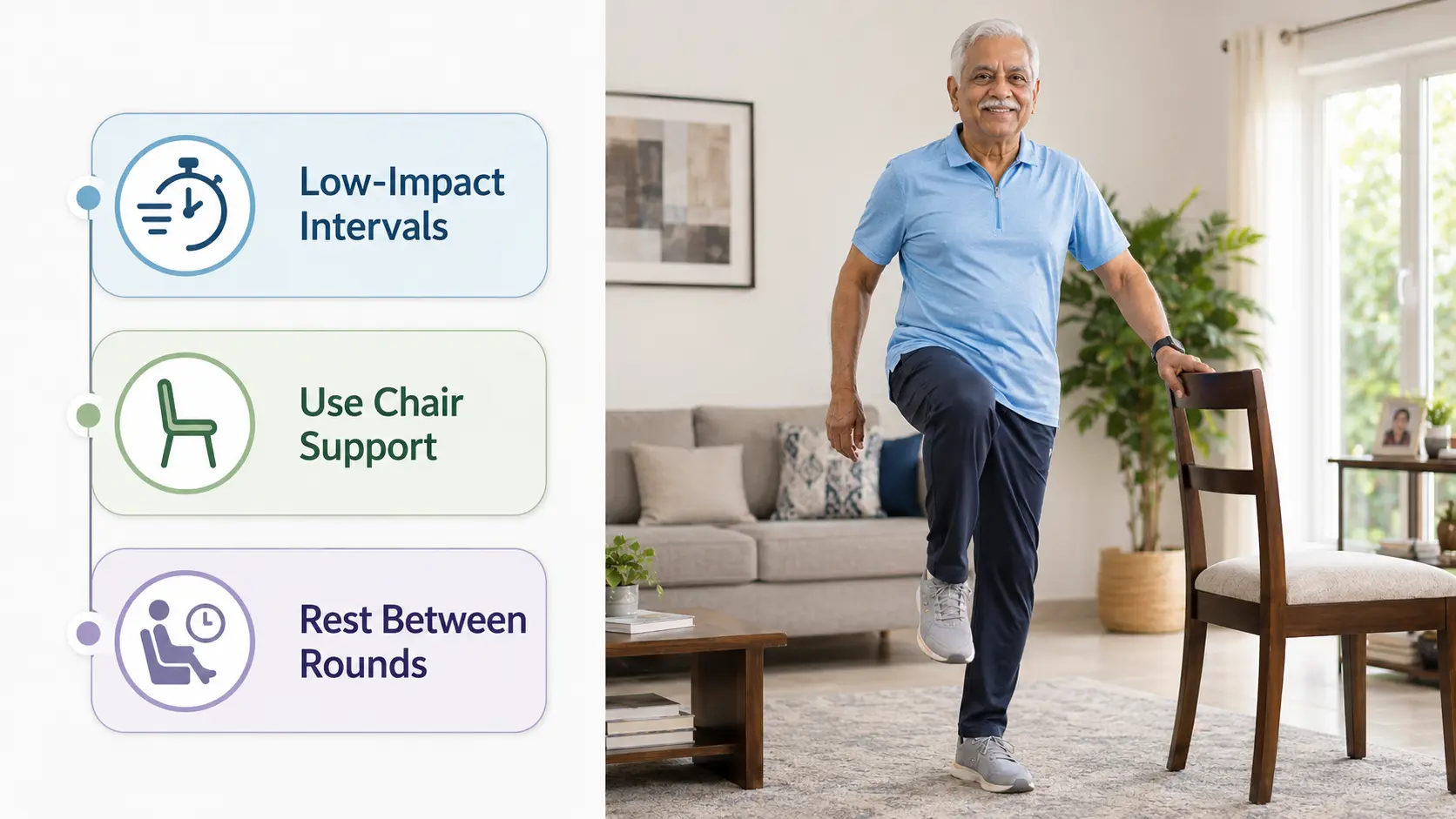
- Keep it low-impact: No jumping, no running. At least one foot stays on the ground at all times.
- Start with longer rest periods: 30 seconds of effort followed by 60 to 90 seconds of rest. The goal is to finish each interval feeling challenged, not drained.
- Know when to stop: Dizziness, chest tightness, or sharp joint pain are signals to stop immediately.
For seniors new to structured exercise, pairing HIIT with basic resistance work helps the body adapt faster. This guide to beginner strength training is a practical starting point.
A Simple HIIT Workout for the Elderly (No Equipment Needed)
This routine uses four low-impact exercises. Do each for 30 seconds, rest for 60 to 90 seconds, then move to the next. Complete two rounds. The whole session takes about 15 minutes.
1. Warm-Up

March in place for 2 minutes by lifting your knees gently and swinging your arms. Follow with slow shoulder rolls, 10 forward and 10 back. This gets blood moving to your muscles before the intervals begin.
2. Seated Marching

Sit upright in a sturdy chair with your feet flat on the floor and your hands resting on your thighs. Lift your right knee toward your chest, lower it, then lift your left. Keep alternating at a pace that feels brisk but controlled for 30 seconds. This works the hip flexors with no joint impact.
3. Wall Push-Up

Stand facing a wall with your feet half a metre back and your palms flat against it at shoulder height. Bend your elbows and lean your chest toward the wall, then push back to the start. Repeat for 30 seconds. This builds the pushing strength used in everyday tasks like opening doors or getting up from the floor.
4. Chair Squat

Stand in front of a sturdy chair, feet shoulder-width apart. Lower yourself until you just touch the seat, then stand back up without using your hands. Repeat for 30 seconds. Trains the leg strength needed to get up from any low seat.
5. Step Touch

Feet together, hands on hips for balance. Step your right foot out to the side, bring your left foot to meet it, then reverse. Keep alternating at a pace that raises your breathing. This keeps heart rate up while working on balance and coordination.
6. Cool-Down

March in place slowly for one minute. Then do a gentle seated calf stretch and a slow chest opener: sit upright, clasp hands behind your back, and draw your shoulders gently together.
Once the routine feels manageable, the next step is not to move faster. Shorten the rest period instead, from 90 seconds down to 60, then add a third round when that feels comfortable.
Recommended Reading:
This article on how to prevent muscle loss explains why resistance work and cardio training work better together than either does alone.
Cardio Alone Will Not Build the Muscle Seniors Actually Need
Cardiovascular training improves how well your heart and lungs work. But it does not build the muscle strength that supports your joints, steadies your balance, or makes it easier to get up from a chair or climb a flight of stairs. That side of fitness requires resistance work, and without it, the benefits of HIIT have a ceiling. That is what strength training equipment for seniors, like Ferra, is built to develop.
- Ferra uses concentric-only resistance, meaning it challenges your muscles on the effort phase but never loads them on the way down.
- This removes the part of traditional resistance training that causes joint strain and next-day soreness.
- The resistance adjusts automatically to your current strength level, so there is no risk of overloading a joint.
If you want to train safely at home without weights or a complicated setup, Ferra is where to start.
Conclusion
A HIIT workout does not need to look intense to be effective. Start with generous rest periods and exercise at a pace that feels challenging but manageable. As the routine becomes comfortable, shorten the rest periods and let the sessions grow from there.
A few weeks in, you will notice fewer pauses on the stairs, more steadiness on uneven ground, and less effort on the morning walk. That is what consistent training does.
HIIT Workout for the Elderly: Frequently Asked Questions
1. How many times a week should seniors do HIIT?
Daily movement is the goal, but HIIT specifically places demand on the cardiovascular system and needs recovery time between sessions. Avoid consecutive days, especially in the first few weeks, and listen to how your body feels after each session.
2. Is HIIT safe with high blood pressure?
It can be, but check with a doctor first. Many older adults with controlled blood pressure train safely with low-impact HIIT. Keep intensity moderate and monitor how you feel during and after each session.
3. How long before results show up?
Most people notice improvements in breathlessness and energy within three to four weeks. Measurable cardiovascular changes generally show up within six to eight weeks. Consistency matters more than intensity at the start.
4. Can HIIT be done with knee or hip pain?
Yes, with modifications. All four exercises in this routine avoid deep joint loading. If a movement causes pain rather than effort, swap it for seated marching or wall push-ups. If pain persists, speak to a physiotherapist before continuing.
5. Is any equipment needed for HIIT at home?
No. This routine uses only a sturdy chair and a wall. For older adults who want to add resistance training alongside HIIT, Ferra uses concentric-only resistance and auto-adjusts to your current strength level, making it straightforward to train safely at home without weights or complicated setup.
6. Is HIIT better than walking for seniors?
Both serve different purposes. Walking supports daily movement and joint health. HIIT challenges the cardiovascular system in ways steady walking cannot. The best approach combines both.