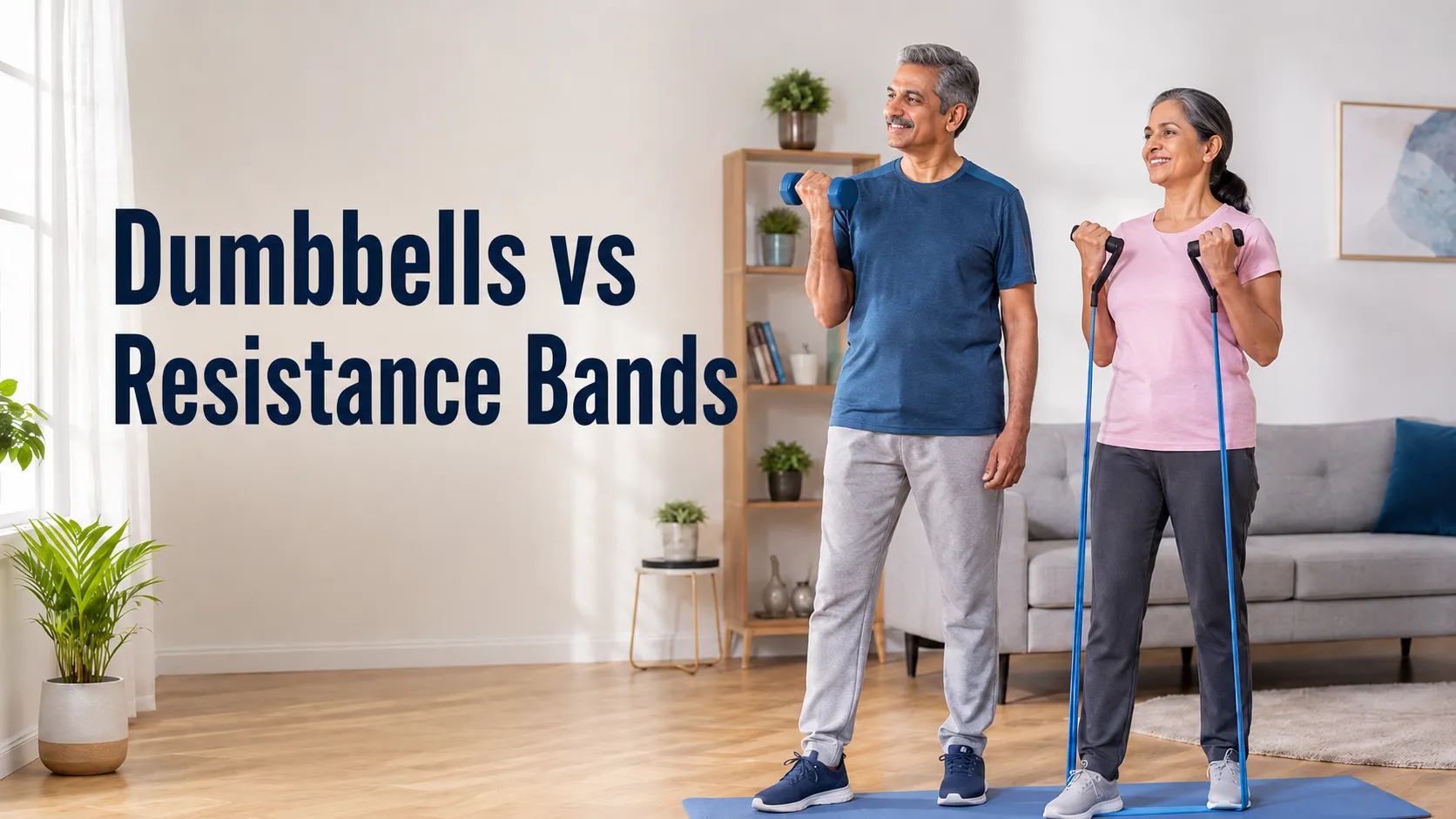
If you have ever searched for home workout equipment, you have probably landed on the same two options: dumbbells and resistance bands. So when it comes to dumbbells or resistance bands, which one do you actually buy?
Both options share a few things in common:
- Affordable
- Compact
- Promise to keep you strong as you get older
For older adults, the dumbbells vs resistance bands choice is less about which tool is better in general and more about which one fits your joints, your consistency, and your real home environment.
Why the Equipment You Choose Matters More After 40
After 35, the body starts losing muscle mass at roughly 3 to 8 percent per decade, a process called sarcopenia. After 60, that rate accelerates. This shows up in everyday tasks that start feeling harder:
- Carrying groceries
- Climbing stairs
- Getting up from a low chair
Resistance training is one of the most effective ways to slow this down. But the tool you use matters, because the wrong equipment can increase soreness, raise injury risk, and make it harder to stay consistent. Consistency, more than any piece of equipment, is what produces results.
Recommended Reading:
If you want to understand what is happening to your muscles as you age, this breakdown on how to prevent muscle loss after 45 gives useful context on why starting sooner helps.
What Resistance Bands Are Actually Good For
Dumbbells work by loading your muscles against gravity. Every rep applies that same force through the full range of motion, which is genuinely useful for building strength over time.
Here is where dumbbells hold a clear advantage:
1/ Measurable Load
You always know exactly how much resistance you are working with, making it easier to track progress over time.

2/ Effective for Pressing Movements
Overhead presses, bicep curls, and rows all work well because the movement fights directly against gravity.

3/ Wide Exercise Variety
Most upper body and lower body compound movements translate well to dumbbells.

Where Dumbbells Get Risky for Seniors
The limitation for seniors is the lowering phase. Every time you lower a dumbbell, your muscles are working eccentrically, the phase most associated with post-exercise soreness and muscle damage.
This shows up in two ways:
- Soreness and recovery: Research on older adult recovery confirms that eccentric exercise causes greater soreness in older adults and takes longer to recover from, compared to younger populations.
- Grip and wrist strain: Holding a dumbbell through a full set requires consistent grip, which can be uncomfortable for those with arthritis or reduced hand strength.
And for someone just starting out, the soreness that follows those first few sessions can easily kill momentum before a routine even takes hold.
What Resistance Bands Are Actually Good For
Resistance bands create tension through stretch rather than gravity. The resistance starts low and increases as the band extends, meaning your joints never absorb a sudden heavy load at the start of a movement. This makes them significantly gentler on the knees, shoulders, and wrists.
Here is where bands hold a real advantage:
- Joint-friendly entry point: The gradual resistance curve reduces abrupt stress on older joints.
- Multi-directional training: Bands can create lateral and rotational resistance that dumbbells simply cannot replicate while standing.
- Compact and affordable: A full set takes up almost no space and costs a fraction of a comparable dumbbell set.
Research cited by ACE Fitness found that older adults who trained consistently with resistance bands improved both muscle mass and strength over a 12-week period.
Where Resistance Bands Fall Short
The drawback is precision. Resistance in a band is hard to measure and standardise, and bands wear out over time.
They are excellent for lighter, mobility-focused work. But loading heavy compound movements like squats with bands is difficult to do safely at home without anchoring support.
Recommended Reading:
If you are setting up a home routine from scratch, these exercises for seniors at home cover a practical mix that works with both tools.
Dumbbells vs Resistance Bands: A Side-by-Side Look
| Factor | Dumbbells | Resistance Bands |
| Joint impact | Moderate to high | Low |
| Soreness risk | Higher (eccentric loading) | Lower |
| Resistance precision | High | Low |
| Progressive overload | Easy to track | Hard to standardise |
| Home storage | Bulky | Compact |
| Cost | Higher | Lower |
| Best for | Pressing, pulling, compound lifts | Lateral, rotational, rehab movements |
| Beginner-friendliness | Moderate | High |
For older adults, neither tool is a complete solution on its own.
- Dumbbells build strength effectively but carry a higher soreness and injury risk for those starting out.
- Bands are safer to begin with but harder to progress systematically over time.
Many fitness professionals suggest using both, which is practical but means more equipment, more cost, and more planning. If you have been putting off strength training for older adults because neither option has felt quite right, that hesitation is worth paying attention to.
Dumbbells vs Resistance Bands: It Comes Down to How Resistance Is Applied
Both dumbbells and resistance bands involve an eccentric phase, the lowering portion of each movement, and that is where most of the soreness and joint stress for older adults comes from. The tool matters less than the type of resistance it delivers.
That loading pattern is what strength training equipment for seniors like Ferra is built around. Ferra removes the eccentric phase from training entirely, which changes what the body actually has to deal with:
- Concentric-only resistance: The machine pushes back against your effort but never loads you on the way down, removing the phase of training that causes the most soreness and the most injury risk.
- Automatic calibration: The resistance adjusts to your current strength level, so there is no guessing which band colour to use or which dumbbell to pick up.
Check out Ferra and build the strength that keeps you capable and consistent at home.
Conclusion
Both dumbbells and resistance bands are legitimate tools for building strength at home. Dumbbells offer precision and load. Bands offer joint-friendly flexibility. For most older adults, the smarter approach is to understand what each tool does well, rather than committing entirely to one.
What matters more than the equipment is showing up for it regularly. Strength builds slowly, and the sessions that feel small are often the ones that add up most. A few weeks from now, you will barely remember how hard that first session used to feel.
Checking these against FAQ rules first: no first-person already holds (these are written as direct questions, not “I”-phrased), but let me check flow and tighten transitions without adding words.Word count down slightly (257 → 247), no first-person anywhere, and each answer now flows into its own close rather than trailing off with a flat caveat sentence:
Dumbbells vs Resistance Bands: Frequently Asked Questions
1/ Can seniors use dumbbells safely if they have joint pain?
Yes, with the right weight and movement range. Light dumbbells used with controlled, slow reps are generally safe for most joint conditions. The key is to avoid going too heavy too fast, since the eccentric (lowering) phase is where most joint stress occurs. If pain increases during or after a session, reducing the load or switching to resistance bands temporarily usually helps.
2/ Are resistance bands strong enough to actually build muscle in older adults?
Yes. Research shows that consistent resistance band training over 12 or more weeks produces meaningful improvements in muscle mass and strength in adults over 60. The challenge needs to increase progressively though, either with heavier bands or less slack, to keep the stimulus effective.
3/ Which is safer for someone who has never exercised before?
Resistance bands tend to be the safer starting point. The variable resistance reduces abrupt joint loading, and there is no risk of dropping a weight. This gives complete beginners enough challenge to start building strength while the body adapts to resistance training.
4/ Is it worth buying both dumbbells and resistance bands?
For many older adults, yes, since each tool covers movements the other cannot. Dumbbells suit gravity-based compound exercises better, while bands work well for lateral and rotational movements. Where space or budget is a concern, starting with bands and adding light dumbbells later as strength improves tends to work well.
5/ What if neither dumbbells nor resistance bands feel comfortable to use?
This is a real concern for many seniors, particularly those with arthritis, reduced grip strength, or balance issues. Equipment like Ferra, which uses concentric-only resistance in a fully seated format, removes both the grip demand and the balance requirement, making it a practical option when conventional tools feel limiting.

Anurag Dani is the Co-Founder of Ferra, a company dedicated to redefining healthy ageing through strength training. Drawing from his experience building fitness and healthy ageing solutions for adults, he writes about healthy ageing to help readers stay strong and independent as they age.