Why is getting up from the floor suddenly so hard?
It didn’t used to be a problem. Now you think twice before sitting down on the floor, because you know getting back up will take effort. That’s not just about age, it’s about weaker legs.
In this article, we’ll cover the safest technique for getting up from the floor for seniors, why this movement gets harder with age, and the exercises that build the leg strength to make it easier again.
Why Getting Up From the Floor Gets Harder With Age
The difficulty is not accidental. Muscle loss, known as sarcopenia, begins around age 35 and accelerates after 60. Research suggests adults lose between 1 and 2 percent of their muscle mass per year after age 50. The muscles most affected are the ones this movement depends on most:
- Quadriceps: push off the half-kneel
- Glutes: hip extension to stand
- Hip flexors: balance through the move
When they weaken, the movement does not disappear overnight. It just gets harder, slower, and eventually avoided. The reassuring part is that muscle loss is not fixed. Resistance training at any age helps maintain the strength needed for this movement.
This isn’t an aging problem. It’s a training gap, and training gaps close.
The Safest Way to Get Up From the Floor
Before attempting to rise, pause and check for pain or dizziness. If something feels wrong, stay still and call for help.
If you are clear to proceed, follow these steps:
- Roll to your side: From lying on your back, bend your knees and roll gently onto one side. Do not try to sit straight up from flat.
- Push to hands and knees: Use your arms to lift your upper body off the floor into a crawling position.
- Crawl toward furniture: Move toward a stable chair, sofa, or low table.
- Come into a half-kneel: Place one foot flat on the floor in front of you, with the other knee still down.
- Push through your front foot to stand: Press your hands down on the furniture, drive through your front heel, and rise to standing.
Getting down safely matters just as much. Most people drop without thinking. The safer approach is to reverse the sequence: half-kneel first, then hands and knees, then lower to the side. The technique is learnable in a single practice session. But how easily you execute it comes down to how much strength you bring to it.
Recommended Reading:
Does hip stiffness make the half-kneel position uncomfortable? These hip pain exercises for seniors target the tightness that restricts this movement.
The Exercises That Make This Movement Easier Over Time
1/ Sit-to-Stand
Sit in a firm chair, feet hip-width apart. Lean forward and push through both heels to rise without using your hands. Lower with control. Do 8 to 10 repetitions. This works the quads and glutes through the same push pattern used when rising from the floor.

2/ Glute Bridge
Lie on your back, knees bent, feet flat. Press through your feet and lift your hips until your body forms a straight line from knees to shoulders. Hold two seconds, then lower. Do 10 repetitions. This builds the glute strength that drives the final push to upright.

3/ Seated Leg Extension
Sit tall in a chair. Slowly extend one leg straight, hold two seconds, then lower with control. Alternate sides for 10 each. This isolates the quadriceps, the primary muscle needed for the half-kneel-to-stand push.

These home exercises for seniors follow the same logic: build the specific strength everyday movements depend on, at home. Consistent practice builds the muscle base that makes the technique above feel easier every week.
Build the Strength That Supports Everyday Movement
Knowing the steps is one thing. Having the leg strength to actually push yourself up is another, and that’s where most people get stuck. The technique only gets you as far as your legs let it.
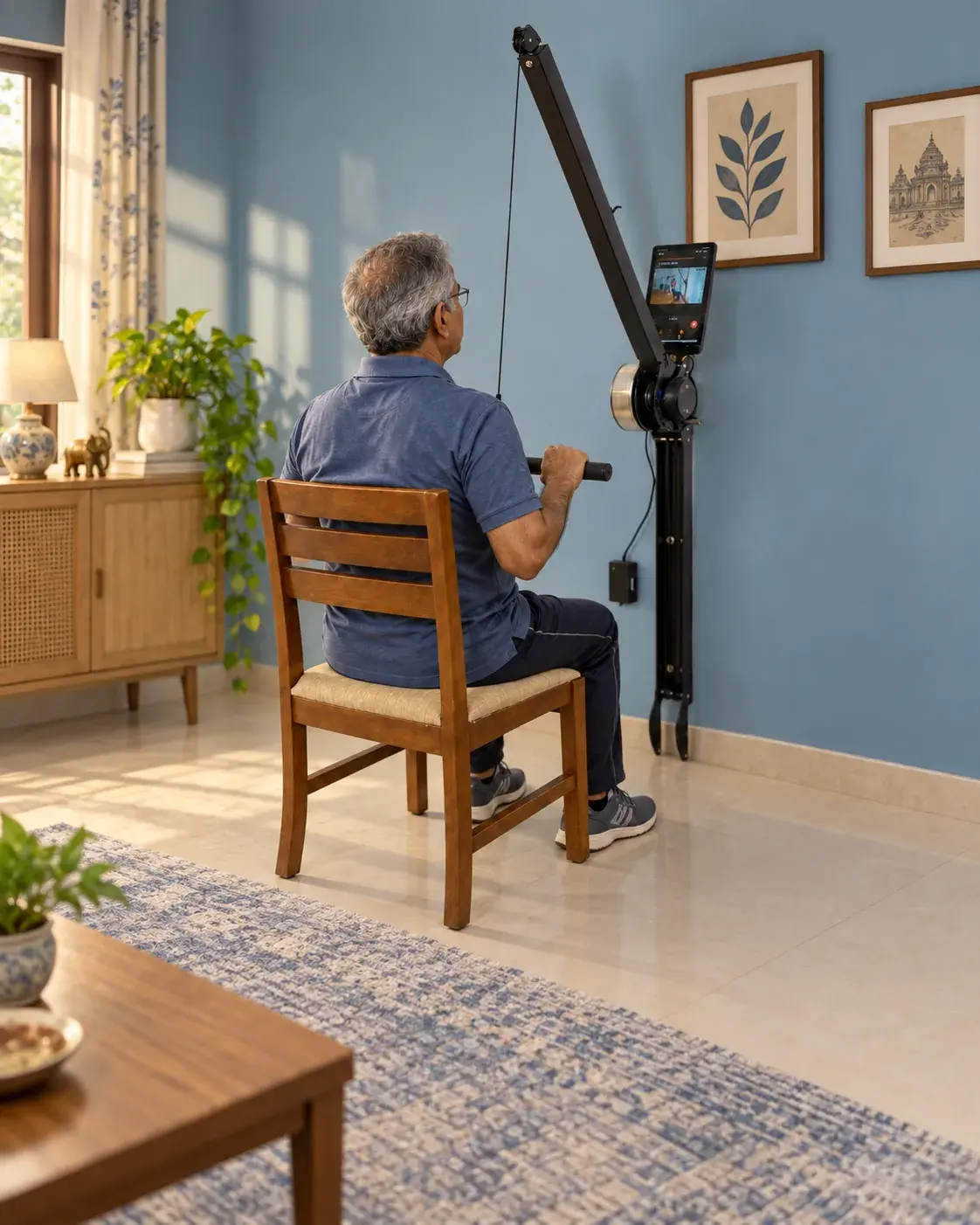
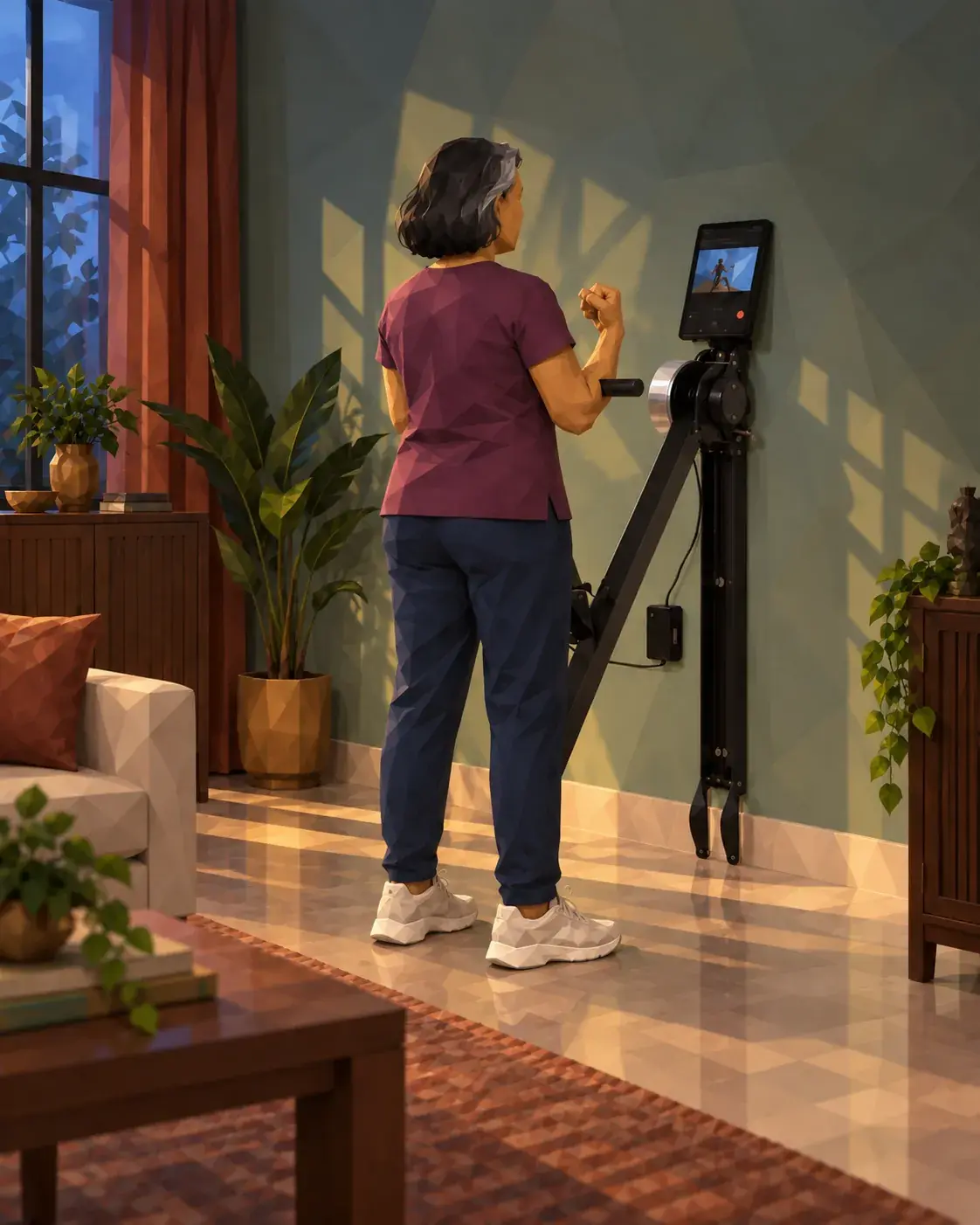
This is exactly what all-in-one home gym machine, like Ferra, is built to do. Ferra uses concentric-only resistance, meaning it resists the effort applied but never loads the body on the way down, similar to pushing a car: stop pushing, and there is zero force working against you.
- No joint soreness from the lowering phase
- Resistance adjusts automatically to current strength
- Seated, guided sessions that fit daily practice
Check out Ferra and build the leg strength that makes getting up from the floor feel effortless.
Conclusion
Getting up from the floor for seniors comes down to strength, not age. Build the quads, glutes, and core, and the movement stops being a struggle. A few weeks of consistent practice is enough to feel the difference. Soon, sitting down on the floor and getting back up is just something you do, no second thought, no hesitation.
Getting Up From the Floor for Seniors: Frequently Asked Questions
1/ Is it normal for seniors to struggle with getting up from the floor?
Yes. Difficulty rising from the floor is common among seniors and is closely linked to age-related muscle loss in the quadriceps and glutes. It does not mean the ability is permanently gone. With consistent leg-strengthening exercises, most people improve this meaningfully within a few weeks.
2/ What should seniors do if there is no furniture nearby to get up from the floor?
If no furniture is available, crawl toward the nearest wall and use it as a brace. Place both hands flat against the wall, walk the feet closer, and use the combined push of arms and legs to rise. If that is not possible, call for help rather than forcing the movement.
3/ Is it safe for seniors to practise getting up from the floor with a knee replacement?
This depends on how recently the surgery occurred and what the surgeon has cleared. Generally, people with knee replacements are advised to avoid deep knee flexion. The half-kneel technique can be modified using a higher support surface to reduce knee bend. Always confirm with a physiotherapist before practising post-surgery.
4/ How long does it take seniors to build enough leg strength to get up from the floor more easily?
Research on leg-strengthening programmes for older adults shows meaningful functional improvement within 8 to 12 weeks of consistent training. The pace depends on starting strength and training regularity. Equipment like Ferra, using concentric-only resistance, allows seniors to train regularly without joint soreness interrupting the routine.
Build everyday strength — at your pace
Explore Ferra to see how strength training fits into life after 50 — it’s not about building muscle for its own sake, but moving with confidence.

Anurag Dani is the Co-Founder of Ferra, a company dedicated to redefining healthy ageing through strength training. Drawing from his experience building fitness and healthy ageing solutions for adults, he writes about healthy ageing to help readers stay strong and independent as they age.