Are stairs, low chairs, or long walks starting to feel harder than they used to?
Weak glutes can make everyday movements more difficult than they need to be. As these muscles lose strength, you may notice:
- Difficulty standing up from a chair or sofa
- Reduced balance and stability while walking
- More strain on the knees and lower back
- Less confidence when climbing stairs
The good news is that glute strength can be improved at any age. With the right exercises, you can strengthen the muscles that support walking, standing, balance, and everyday movement.
In this article, we’ll cover 7 simple glute exercises for seniors that can be done at home to improve mobility, stability, and lower-body strength.
Why the Glutes Weaken With Age
After 35, the body begins losing muscle mass, a process called sarcopenia. The glutes are disproportionately affected because they rely heavily on fast-twitch muscle fibres, which are the first to decline with age and inactivity.
This loss is significant because the glutes are among the body’s most important muscles for movement and stability. Research highlights the importance of maintaining glute strength with age. A PMC review on skeletal muscle atrophy confirms that the gluteal muscles play essential roles in hip stability, posture, and functional movements like walking and climbing.
When the glutes are underactive, the lower back and knees compensate. This is why many older adults experience unexplained back discomfort even without a diagnosed injury. Consistency is what reverses this. Short, regular sessions do more than build muscle, they rebuild the reflex-muscle connection that posture and stability depend on.
7 Glute Exercises for Seniors to Do at Home
These glute exercises for seniors require no equipment and can be done entirely at home.
| Exercise | Primary Target | Equipment Needed |
| Glute Bridge | Gluteus maximus, hamstrings | Floor mat (optional) |
| Chair-Assisted Squat | Gluteus maximus, quads | Sturdy chair |
| Standing Hip Extension | Gluteus maximus | Wall |
| Side-Lying Clamshell | Gluteus medius | Floor mat (optional) |
| Seated Leg Press Against Wall | Gluteus maximus, quads | Wall, chair |
| Donkey Kick | Gluteus maximus | Floor mat or chair |
| Side-Lying Hip Abduction | Gluteus medius, minimus | Floor mat (optional) |
1. Glute Bridge

Lie on your back with your knees bent and feet flat on the floor, hip-width apart. Press through your heels and lift your hips until your body forms a straight line from your knees to your shoulders. Hold for 2 seconds, then lower slowly. Perform 10 to 12 reps for 2 to 3 sets. This exercise targets the gluteus maximus and helps reduce strain on the lower back by strengthening the muscles that support it.
2. Chair-Assisted Squat (Sit-to-Stand)

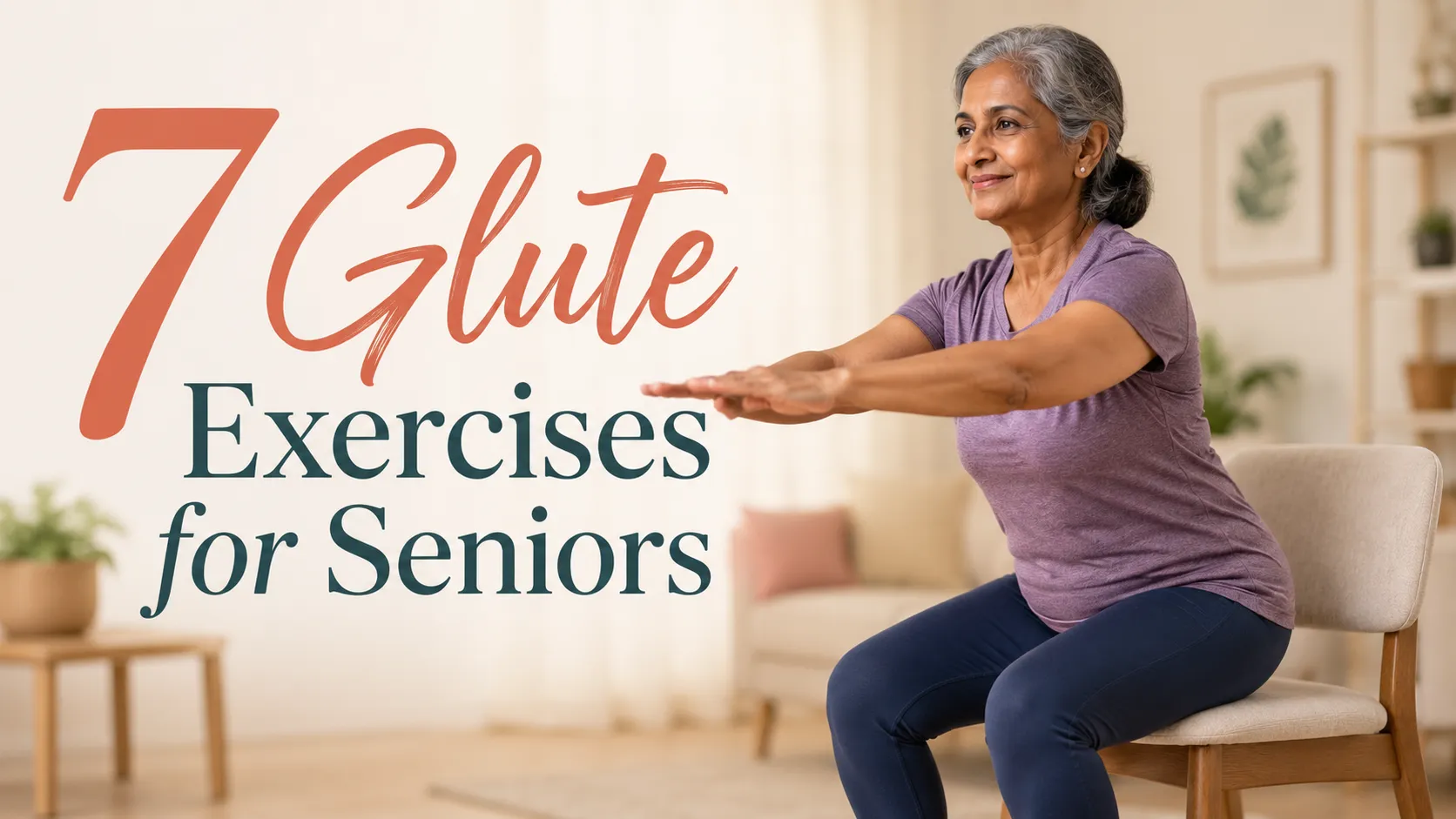
Sit on the edge of a sturdy chair with your feet shoulder-width apart. Lean slightly forward and push through your heels to stand upright. Slowly lower yourself until you lightly touch the seat. Perform 10 reps for 2 to 3 sets. This movement mimics a common daily activity and strengthens the gluteus maximus in the range where it is used most.
3. Standing Hip Extension

Stand facing a wall with both hands resting lightly on it for support. Keeping your leg straight, move one foot backward and slightly upward while squeezing your glute at the top. Hold for 1 to 2 seconds, then return. Perform 10 to 12 reps per leg for 2 sets. This isolates the gluteus maximus without requiring you to get on the floor.
Recommended Reading:
If hip tightness or pain is limiting your range of motion, these hip pain exercises for seniors can help address the underlying issue.
4. Side-Lying Clamshell

Lie on your side with your hips and knees bent at 45 degrees and your feet stacked. Keeping your feet together, lift the top knee as high as comfortable without rotating your pelvis. Lower with control. Perform 12 to 15 reps per side for 2 sets. This exercise targets the gluteus medius, a key muscle for balance and hip stability.
5. Seated Leg Press Against Wall

Sit in a chair close to a wall and place both feet flat against it at knee height. Press into the wall through your heels while squeezing your glutes. Hold for 3 to 5 seconds, then relax. Perform 10 to 12 reps. This activates the gluteus maximus without placing extra stress on the lower back or knees.
6. Donkey Kick

Start on your hands and knees with your back flat. Keeping one knee bent at 90 degrees, lift your foot toward the ceiling until your thigh is level with the floor. Lower with control. Perform 10 to 12 reps per side for 2 to 3 sets. This movement strengthens the gluteus maximus and supports the push-off phase of walking.
7. Side-Lying Hip Abduction

Lie on your side with your legs straight and stacked. Keeping the top leg straight and toes pointed forward, lift it to about 45 degrees. Pause briefly, then lower slowly. Perform 12 to 15 reps per side for 2 sets. This exercise works the gluteus medius and minimus, which help stabilise the hips and keep the pelvis level while walking.
These glute exercises for seniors target the entire glute muscle group, helping improve strength, stability, and confidence in everyday movement.
How to Build a Daily Glute Exercise Routine
The most common mistake with glute training is doing too much too soon. The glutes respond best to consistent daily movement, not occasional long workouts.
Here is a simple way to start:
- Pick 3 to 4 exercises from the list above. The glute bridge, chair-assisted squat, and clamshell are a great starting combination.
- Move slowly and with control to keep the muscles engaged.
- Stop when the muscle feels fatigued, not when the joint starts to ache.
- Progress gradually by adding a few reps or another exercise as the movements become easier.
You do not need long sessions to see results. A few minutes of focused exercise each day can go a long way.
Recommended Reading:
If you are starting from scratch or helping a parent build a routine, the exercises for seniors at home guide covers how to begin without a gym and without overcomplicating things.
Glute Exercises for Seniors Work Best With Consistent Resistance
Bodyweight exercises are an excellent starting point. But as the glutes grow stronger, bodyweight alone stops being challenging enough. The muscle adapts, and the stimulus that drove progress disappears.
This is where strength training equipment for seniors, like Ferra, makes a practical difference. Designed to support safe and effective strength training at home, Ferra offers:
- Concentric-only resistance reduces joint strain
- No eccentric phase means less soreness
- Resistance adjusts automatically to your strength level
Check out Ferra and build the glute strength that keeps daily movement effortless.
Conclusion
Strong glutes play an important role in mobility, balance, and everyday independence. Simple movements like walking, climbing stairs, and standing up from a chair all rely on healthy glute muscles.
The glute exercises for seniors in this guide target the entire glute group, helping improve lower-body strength, stability, and movement quality. With consistent daily practice, these exercises can make everyday activities feel easier and more comfortable over time.
The key is to start small, stay consistent, and focus on gradual progress.
Glute Exercises for Seniors: Frequently Asked Questions
1/ How long does it take to see improvement in glute strength?
Most people notice a difference within 3 to 4 weeks of consistent training. The initial gains come from better muscle activation and coordination, not just muscle size. Strength gains become more visible by 6 to 8 weeks when the sessions are regular and progressive.
2/ Is it normal to feel a burn in the glutes during exercise?
A working burn inside the muscle during exercise is normal and expected. Soreness the following day in the muscle belly is also common after a new session. Sharp pain during an exercise, or discomfort in the joint rather than the muscle, is a signal to stop and check form or reduce the range of motion.
3/ Can glute exercises help with lower back pain?
Yes. Weak glutes are a common contributing factor to lower back strain because the lower back compensates when the glutes are not carrying their share of the load. Strengthening the gluteus maximus and medius directly reduces the demand placed on the lumbar muscles. Equipment like Ferra, which uses concentric-only resistance, makes this kind of targeted glute work accessible at home without soreness risk.
4/ What are the best alternatives for seniors who cannot get down to the floor?
The standing hip extension, chair-assisted squat, and seated leg press against a wall all work the glutes effectively without requiring floor access. For the bridge and clamshell, a firm bed can substitute for the floor while maintaining the same movement pattern.

Anurag Dani is the Co-Founder of Ferra, a company dedicated to redefining healthy ageing through strength training. Drawing from his experience building fitness and healthy ageing solutions for adults, he writes about healthy ageing to help readers stay strong and independent as they age.