Blogs
5 Knee Osteoarthritis Exercises: Ease Pain & Strengthen Your Knees at Home
Is knee pain turning simple tasks into a challenge?
Things like climbing stairs, getting up from a chair, or walking to the market should feel effortless. But for adults dealing with knee osteoarthritis, a condition where the cartilage cushioning the knee joint gradually wears down, these everyday movements are anything but effortless.
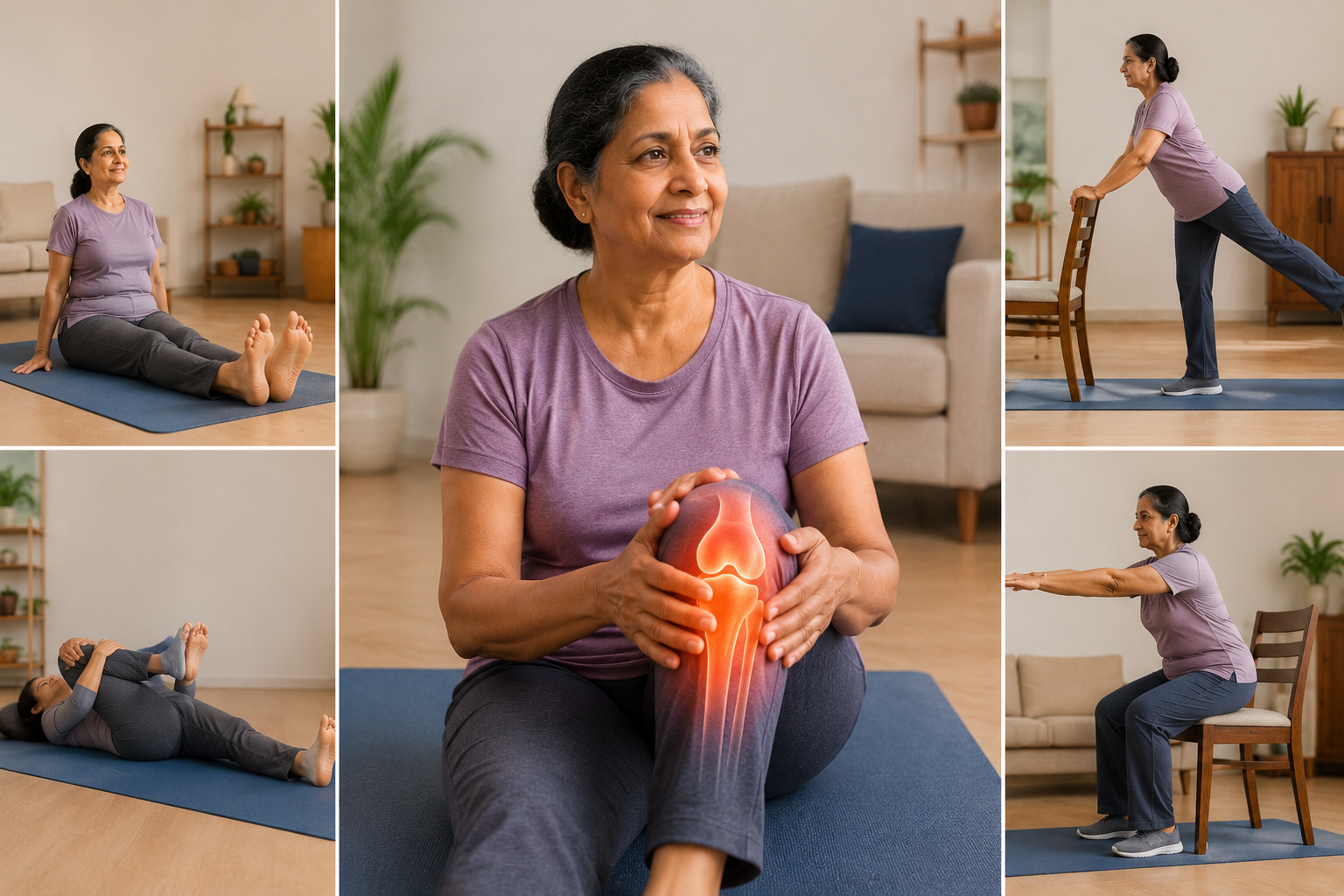
In this article, we look at five home-based knee osteoarthritis exercises that can help reduce that pain and build the strength your knees need to move better.
Why Knee Osteoarthritis Gets Worse When You Stop Moving
Cartilage does not have a direct blood supply. It depends on movement to receive nutrients and stay healthy. When movement stops, the cartilage deteriorates faster, and the joint becomes increasingly stiff.
At the same time, the muscles that support the knee begin to weaken:
- Quadriceps: The muscles at the front of your thigh that absorb load during walking and standing
- Hamstrings: The muscles at the back of your thigh that stabilise the knee during movement
- Glutes: The hip muscles that control how weight is distributed through the leg
When any of these weaken, the knee joint carries more load than it should. That is where exercise becomes important. A systematic review of 39 studies found that exercise consistently reduced pain and improved function in knee OA patients.
Recommended Reading:
Not sure where to begin? These exercises for seniors at home are a practical starting point.
5 Knee Osteoarthritis Exercises You Can Do at Home
1. Seated Leg Raise

Sit upright in a firm chair with both feet flat on the floor. Slowly straighten one leg until it is parallel to the floor, hold for 3 seconds, then lower it back down. The movement strengthens the quadriceps without placing any load on the knee joint itself. Do 10 repetitions on one leg, then switch to the other. Complete 2 to 3 sets on each side.
2. Shallow Wall Sit

Stand with your back flat against a wall, feet shoulder-width apart and about 30 cm away from it. Slowly slide your back down until your knees are at a slight bend. Hold for 5 to 10 seconds, then slide back up to standing. The wall supports your back throughout, making this a safe way to build quad and glute strength without straining the knee.
3. Calf Raise

Stand behind a chair and hold the back lightly for balance. Rise up onto the balls of both feet, hold for 2 seconds, then lower slowly back down. This strengthens the lower leg and improves circulation around the knee, both of which contribute to overall joint stability. Aim for 10 to 15 repetitions per set.
4. Mini Squat (Chair-Assisted)

Stand directly in front of a sturdy chair. Slowly lower yourself as if you are about to sit, stopping just before you make contact with the seat. Hold for 2 seconds, then stand back up. Keep your knees behind your toes and your weight through your heels throughout the movement.
This trains the exact motion of sitting and standing, one of the most demanding daily tasks for anyone with arthritic knees.
5. Straight Leg Deadlift (Supported)

Stand behind a chair or counter and hold it lightly for support. With a slight bend in both knees, hinge forward at the hips with your back straight and chest leading, until you feel a gentle stretch in the back of your thighs. Then return to standing. This strengthens the hamstrings and glutes, the muscles that take load off the knee during walking and stair climbing.
Recommended Reading:
If you notice any tension in the lower back during this movement, pairing it with lower back pain exercises can help.
Knee Osteoarthritis Exercises Depend on the Right Kind of Resistance
The exercises in this article work because they strengthen the muscles that take the load off the knee joint. But the way resistance is applied matters just as much as the exercise itself. The lowering phase of any movement is where most gym exercises and free weights place the most demand, and it is exactly where arthritic knees are most vulnerable. To keep making progress without setbacks, the resistance needs to work with your joints, not against them.
That is the problem Ferra, a strength training equipment for seniors, is built to solve. It uses concentric-only resistance, meaning the machine supports you through the lowering phase entirely, so your muscles are strengthened without the joint stress that usually follows. Resistance is digitally controlled and adjusts automatically, so there is no risk of accidentally overloading a sensitive knee. And because it is home-based, there is no commute, no crowded gym, and no reason to skip a session.
Check out Ferra and build the knee-supporting strength that makes daily movement easier.
Conclusion
Living with knee osteoarthritis does not mean accepting pain as the new normal. The exercises above are low-impact, home-based, and designed to work with your joints rather than strain them. A few minutes of consistent movement each day is enough to begin building the strength that supports your knees. The goal is not to push through pain or train like an athlete. It is to stay strong enough to move through your day with less effort and more confidence. That kind of strength is built gradually, and it starts at home.
Knee Osteoarthritis Exercises: Frequently Asked Questions
1. Can these exercises be done during a flare-up?
Yes, with modifications. During a flare-up, reduce the range of motion rather than stopping entirely. Seated leg raises and calf raises are usually the most comfortable to continue. Avoid deep bending movements until the flare settles.
2. Are these exercises safe for someone with both knee and hip pain?
Yes, most of them are. The seated leg raise and calf raise place minimal stress on the hip and are generally safe to continue. For the mini squat and wall sit, keep the range of motion shallow. If hip pain is significant, check with a physiotherapist before adding the straight leg deadlift.
3. How long before results show from knee osteoarthritis exercises?
Most people notice a gradual improvement in pain and ease of movement after six to eight weeks of consistent practice. Strength gains tend to come before pain relief, so you may feel more stable before you feel less sore. Either way, both are signs that the exercises are working.
4. Do you need any equipment for knee osteoarthritis exercises at home?
No. All five exercises in this article require only a sturdy chair or a wall for support. However, as you get stronger, adding structured resistance training at home with a machine like Ferra can help you build on that foundation more effectively.

Anurag Dani is the Co-Founder of Ferra, a company dedicated to redefining healthy ageing through strength training. Drawing from his experience building fitness and healthy ageing solutions for adults, he writes about healthy ageing to help readers stay strong and independent as they age.