Wondering if a small corner of your living room is even enough to build real strength?
You are not alone. Most people assume strength training needs a dedicated space. It does not.
What actually matters is not how much space you have. It is what kind of movement that space allows you to do safely, especially as your body changes with age. A few square feet, used consistently, can do more for your strength than an empty room used once a month.
Most Small Space Workout Advice Isn’t Built for This Stage of Life
Search “small space workouts,” and most results point to the same set of moves: burpees, jump squats, floor planks, glute bridges. These work fine for someone who can drop to the floor and pop back up without a second thought.
That is where the advice falls short for older adults. Getting down to the floor and getting back up is often the hardest part of the whole workout, harder than the exercise itself. As Harvard Health points out, even people in tight spaces can still do bodyweight exercises like push-ups, bridges, squats, and mat Pilates, but not every one of these needs to happen on the floor.
A few reasons floor-heavy routines create unnecessary risk:
- Getting up and down repeatedly strains the knees and lower back
- Balance issues make floor transitions the riskiest part of the session, not the exercise itself
- Joint stiffness makes low positions uncomfortable before the workout even begins
Skipping the floor entirely does not mean skipping strength. It means choosing movements that build the same muscles from a seated or standing position instead.
Recommended Reading:
If floor-based moves have been causing stiffness or strain, these lower back pain exercises for seniors are a gentler place to start
What Actually Makes a Small Space Work for Strength Training
A small space works well when the movements in it do not depend on floor space to begin with. A wall, a sturdy chair, and enough room to stand with your arms out is genuinely enough.
What this looks like in practice:
- Seated exercises replace the need for a bench or mat
- A wall doubles as resistance equipment for push and pull movements
- Standing exercises with light resistance build strength without any floor transitions
- The same small corner used daily builds more strength than a bigger space used occasionally
If you have ever tried to stay fit at home without a gym, you already know that consistency in one small, fixed spot beats a big room you rarely get around to using. That consistency is what turns a corner of a room into a real strength training spot, more than the size of the room ever will.
Recommended Reading:
If you are not sure where to begin, these exercises for seniors at home are a practical starting point that follows this same floor-free approach.
Small Space Exercises That Skip the Floor Completely
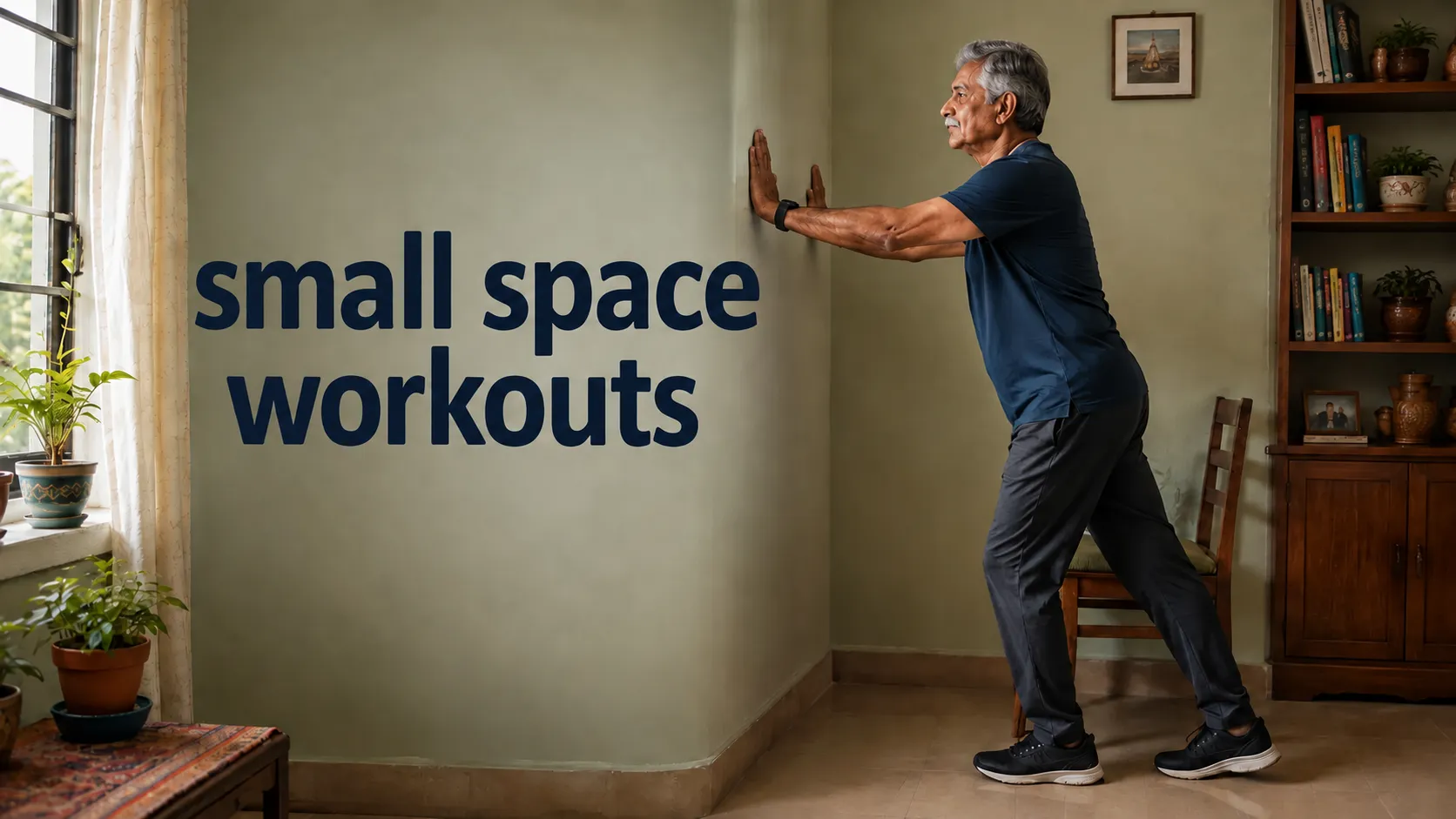
1/ Wall Push-Ups
Stand facing a wall, arms extended, palms flat against it at shoulder height. Bend your elbows and lean your chest toward the wall, then push back to start. Do 10 to 12 reps for 2 sets. This builds chest and arm strength without any pressure on the wrists or knees.

2/ Seated Rows with a Door Band
Sit facing a resistance band anchored to a door, holding one end in each hand with arms extended. Pull your elbows back, squeezing your shoulder blades together, then release slowly. Do 10 to 12 reps for 2 sets. This strengthens the mid-back muscles that support posture.

3/ Standing Bicep Curls
Stand with feet hip-width apart, holding light weights or a filled water bottle in each hand. Curl your hands toward your shoulders, then lower with control. Do 10 to 12 reps for 2 sets. This builds the arm strength carrying groceries and bags.

4/ Chair-Assisted Squats
Stand in front of a sturdy chair, feet shoulder-width apart. Lower slowly until you lightly touch the seat, then push back up to standing. Do 8 to 10 reps for 2 sets. This builds the leg strength that makes sitting down and standing back up easier every day..

These four moves cover pushing, pulling, and leg strength without a single floor transition, which is what makes them realistic to repeat daily in a small space.
Small Space Workouts Still Need Resistance That Adjusts to You
Bodyweight and band exercises are a strong starting point, but they hit a ceiling fast. A band offers roughly the same resistance every rep, and once a movement feels easy, there is no built-in way to make it harder without buying heavier bands or more equipment, which brings back the storage problem a small space was supposed to solve.
That is the gap a smart home gym machine like Ferra is built to close:
- Resistance adjusts automatically as you get stronger, so there is no ceiling to hit
- It mounts on the wall, using the same footprint as the ex{ercises above
- It applies concentric-only resistance, so it resists your effort but never loads you on the way down
- Every exercise is done fully seated, so there is no floor work at any point in the session
Check out Ferra and build the strength this small space was always capable of supporting, without ever needing more room than you already have.
Conclusion
A small space was never really the obstacle. Floor-dependent advice built for a different body was. Once you shift to seated and standing movements that use a wall, a chair, and a band, the same corne}}r you were unsure about becomes enough.
What matters most now is showing up in that same spot regularly. A few weeks of consistent sessions in a small, fixed space will do more for your strength than any amount of floor space used occasionally.
Frequently Asked Questions About Small Space Workouts
1/ Do small space workouts require any equipment?
No, not to get started. Bodyweight exercises like wall push-ups and chair-assisted squats need nothing more than a wall and a sturdy chair. A resistance band adds variety once the basics feel easy.
2/ Are small space workouts safe for people with balance issues?
Yes, when the exercises are seated or standing near a wall or chair for support. Avoiding floor transitions removes the riskiest part of most home workout routines for someone managing balance concerns.
3/ How much space is actually needed for these workouts?
Enough room to stand with arms fully extended in every direction is usually enough. Most of the exercises in this article can be done in a space smaller than a yoga mat.
4/ How often should small space workouts be done?
Aim for short sessions most days rather than one long session occasionally. Machines like Ferra, which use concentric-only resistance, are designed specifically to make short daily sessions effective without soreness.
5/ Can small space workouts actually build muscle?
Yes. Muscle responds to consistent resistance, not to the size of the room it happens in. Seated and standing exercises with progressive resistance can build real strength over time.

Anurag Dani is the Co-Founder of Ferra, a company dedicated to redefining healthy ageing through strength training. Drawing from his experience building fitness and healthy ageing solutions for adults, he writes about healthy ageing to help readers stay strong and independent as they age.