You've been sitting for most of your workday, every day, for years.
How is your back holding up?
If you spend eight or more hours at a desk, waking up stiff or feeling tension between your shoulder blades by afternoon probably feels normal by now. Many people quietly accept this as part of the job.
It isn't. Back stiffness from sitting happens when the muscles that hold your spine upright go hours without doing any real work. The right back exercises for people who sit all day can rebuild that support and ease the discomfort desk work creates.
Why Sitting All Day Causes Back Stiffness
Sitting for long stretches changes how your body supports your spine.
Three muscle groups weaken when you stay seated most of the day:
- Glutes, which stabilize the pelvis.
- Core muscles, which protect the lower back.
- Hip flexors, which tighten and pull the pelvis forward.
Screen work also pulls the head forward. This posture can add up to 27 kg of extra load on the neck, increasing tension through the upper back.
For India's IT professionals, long workdays, back-to-back meetings, and poorly set up home offices make this worse. Multiple studies suggest a majority of software professionals experience neck or back pain by their late 30s, with some surveys reporting prevalence above 50 to 60% among IT workers.
This is why structured back exercises for people who sit all day matter for anyone spending most of the day at a desk.
Recommended Reading:
Desk-related stiffness compounds over time if it's left unaddressed. If you're curious how this plays out over the years, our blog on how age-related muscle loss shows up breaks down what changes and why it matters.
5 Back Exercises for People Who Sit All Day
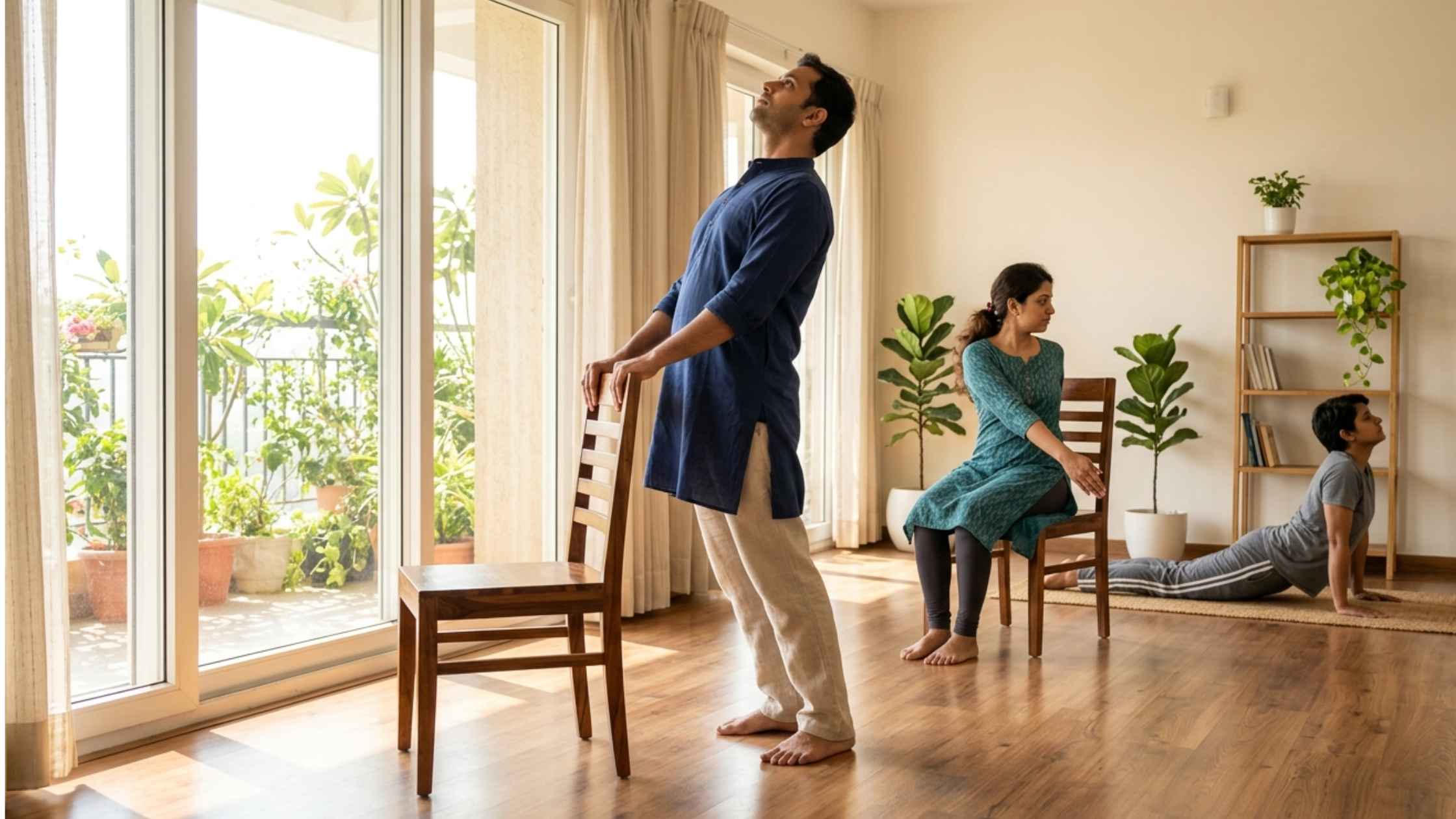
These five back exercises target the exact muscle imbalances created by desk work. They require minimal time and no complex setup, similar to these simple home exercises that skip the gym equipment entirely.
1. Thoracic Extension Over Chair

Sit at the edge of your chair and place your hands behind your head. Gently arch your upper back over the chair. This eases thoracic stiffness caused by prolonged forward posture. Do it every 90 minutes at work, it takes only 30 seconds.
2. Wall Angels

Stand with your back flat against a wall, keep your arms at a 90 degree angle, and slowly slide your arms upward and back down. This targets rounded shoulders and a weak upper back. If your arms lose contact with the wall, your chest muscles are tight, and that improves gradually.
3. Seated Row (Resistance-Based)

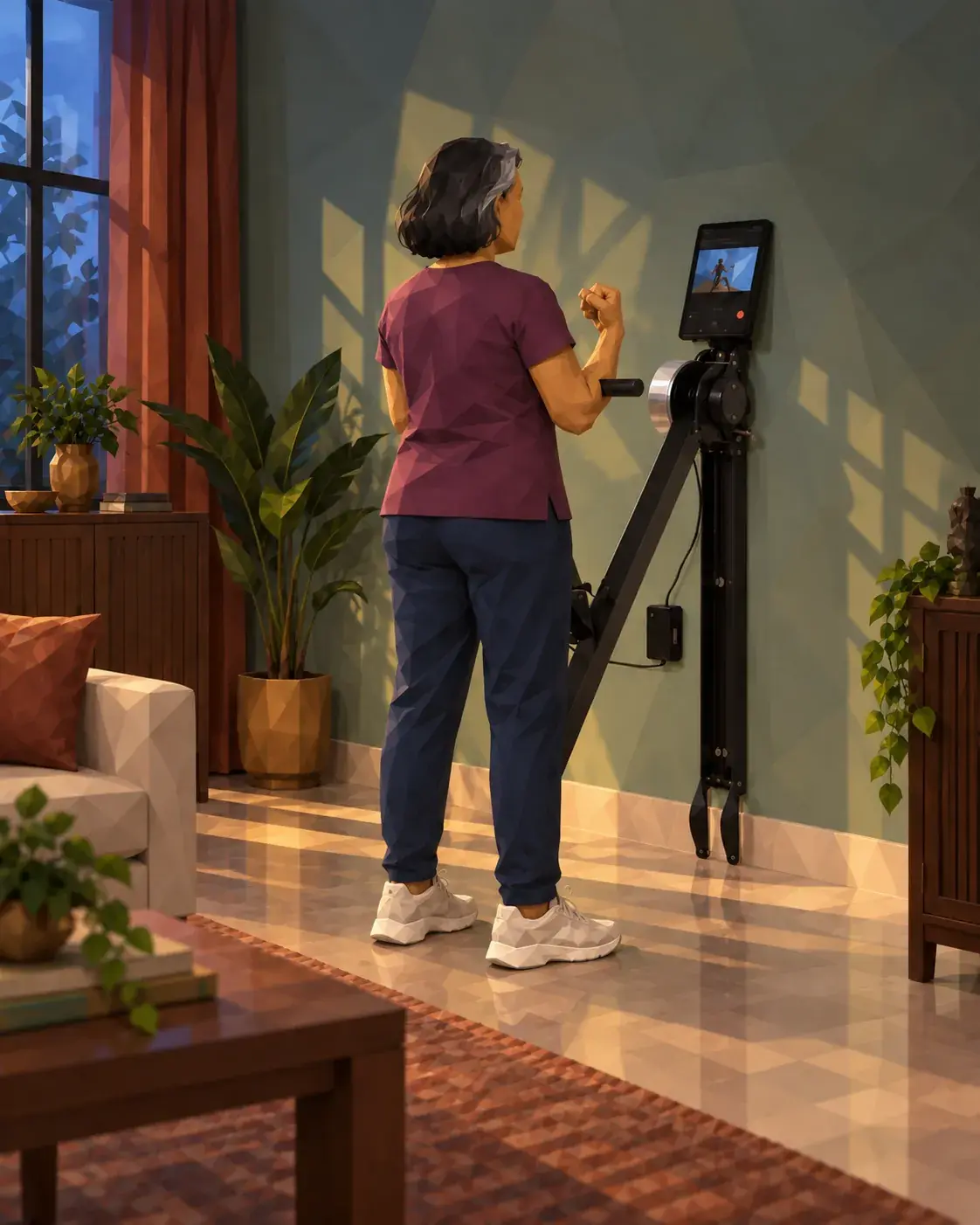
Sit upright and pull handles or resistance toward your torso, then release slowly. This strengthens the upper back muscles weakened by prolonged keyboard posture. Focus on squeezing your shoulder blades together at the end of each pull. If your neck and shoulders feel stiff too, pairing this with shoulder mobility exercises helps round out the routine.
4. Dead Bug

Lie on your back with arms pointing toward the ceiling and knees bent at 90 degrees. Lower one arm and the opposite leg slowly toward the floor, then return and alternate sides. This builds the deep core stability that protects your lower back. Keep your lower back flat on the floor, and reduce the range if it lifts.
5. Hip Flexor Doorway Stretch

Step into a lunge position in a doorway, tuck your pelvis slightly under, and hold for 30 seconds. This releases tight hip flexors caused by prolonged sitting. This single stretch often reduces more desk-related back pain than many complex routines.
Practicing these back exercises for people who sit all day consistently restores strength where desk work weakens the body.
When Strength Matters More Than Stretching Alone
Stretching and mobility work, like the exercises above, ease stiffness in the moment. They loosen tight hip flexors and open up a rounded upper back. But stretching alone doesn't fix the underlying problem: muscles too weak to hold your spine upright for eight hours a day.
That's usually the next sign to look for. Once stiffness starts easing but tension keeps returning by the afternoon, it means the muscles supporting your spine, your glutes, core, and upper back, need more than a stretch. They need resistance.
This doesn't mean a gym membership or heavy weights. Strength training equipment for seniors and desk-bound professionals alike, such as Ferra's seated row, applies adaptive concentric-only resistance that builds this strength without adding joint strain. That matters if you're already dealing with stiffness from sitting.
If stretching hasn't fully resolved your back stiffness after a few consistent weeks, that's the signal to add strength work into the routine.
How Often to Do These Back Exercises for Lasting Relief
For lasting relief, back exercises for people who sit all day work best as a daily habit, not an occasional fix.
A practical approach:
- Perform the thoracic extension and wall angels every 90 minutes during work hours.
- Do the full 5-exercise routine once a day, ideally right after logging off.
- Stand up and move for 2 minutes every hour, even without a full routine.
None of this requires an intense workout. It's about waking up the muscles that sitting switches off, consistently, so the stiffness doesn't have a chance to rebuild overnight.
The Bottom Line
Back stiffness from sitting doesn't fix itself over the weekend. It improves when the muscles supporting your spine get worked consistently instead of being switched off for eight hours a day.
Start with the 5 exercises above. Build them into your workday, and if stiffness keeps returning after a few weeks of consistent stretching, that's your cue to add strength work.
A few weeks of consistent practice, and the tension that used to show up by mid-afternoon starts to feel like something you left behind at your desk.
FAQs on Back Exercises for People Who Sit All Day
1. How often should desk workers do back exercises?
Once daily is the minimum for lasting results. Desk workers should aim for a short back exercise routine once a day, ideally after work, along with brief movement breaks every hour during the day. Consistency matters more than duration.
2. Can stretching alone fix sitting-related back stiffness?
No, not on its own. Stretching relieves tension in the moment by loosening tight hip flexors and a rounded upper back, but it doesn't address the underlying weakness in the muscles that hold your spine upright. Lasting relief usually needs both mobility work and some resistance training.
3. When should someone add strength work for back support?
Once stretching stops fully resolving the stiffness, usually after a few weeks of consistent practice, it's a sign the muscles supporting your spine need more than mobility work. Adding strength training for older adults at that point, such as machines like Ferra that use concentric-only resistance, builds the strength stretching alone can't.
4. Do desk workers need special equipment for these exercises?
No. Four of the five exercises need nothing more than a chair, a wall, or open floor space. The seated row is the only one that benefits from resistance, such as a band or a machine like Ferra's seated row, though bodyweight variations work too when starting out.
5. How long before back stiffness from sitting starts to improve?
Most people notice less stiffness within 2 to 3 weeks of doing the routine daily. Full relief from long-term postural imbalances can take 6 to 8 weeks of consistent practice, especially if the stiffness has built up over several years of desk work.
Build everyday strength — at your pace
Explore Ferra to see how strength training fits into life after 50 — it’s not about building muscle for its own sake, but moving with confidence.

Anurag Dani is the Co-Founder of Ferra, a company dedicated to redefining healthy ageing through strength training. Drawing from his experience building fitness and healthy ageing solutions for adults, he writes about healthy ageing to help readers stay strong and independent as they age.