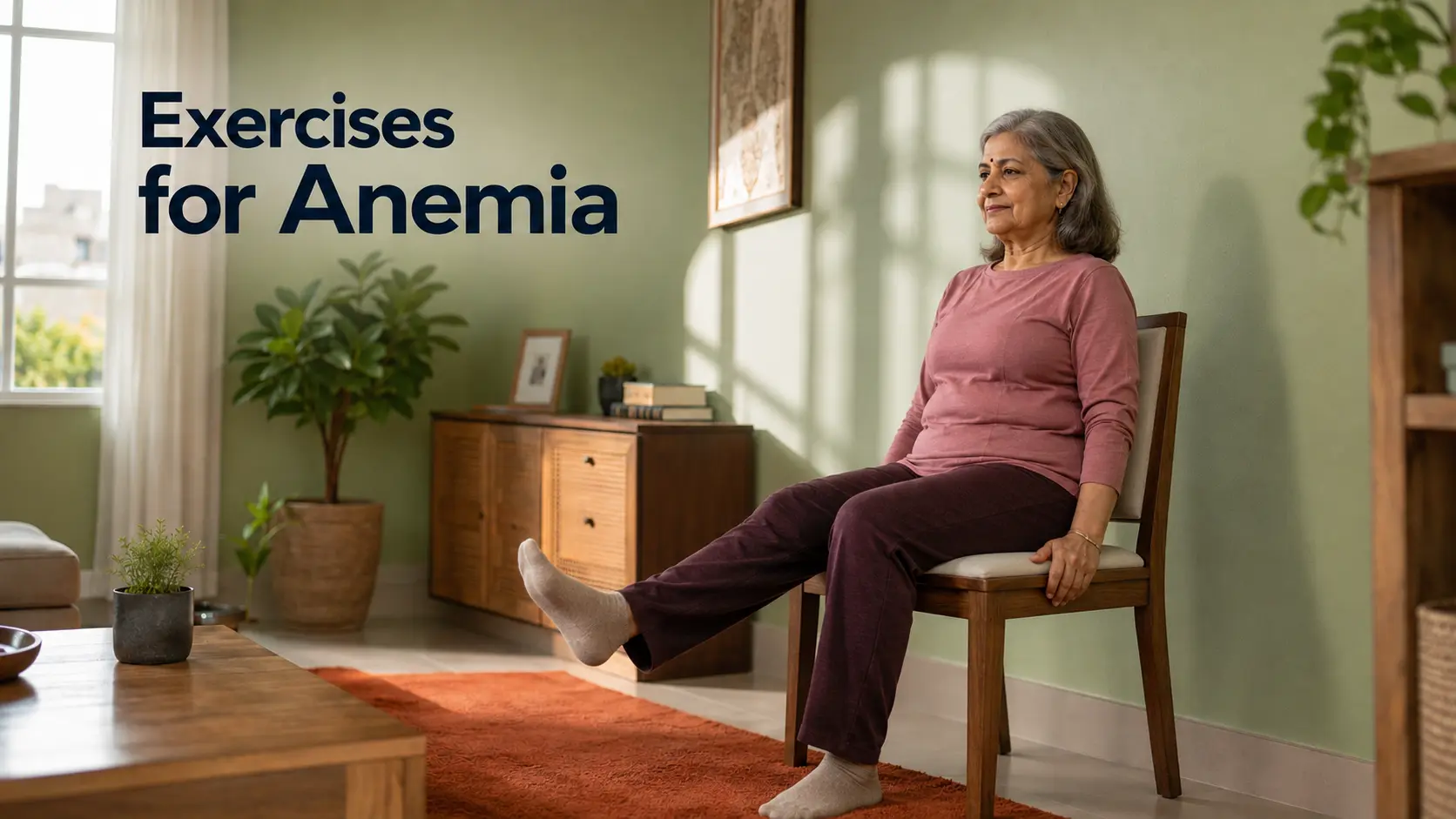
Do your legs feel heavy and tight by the end of the day?
For seniors and older adults managing leg lymphedema, this is a familiar pattern, and it rarely gets better on its own. Left unmanaged, the swelling stiffens the ankles, makes shoes and socks feel tighter, and slows down everyday movement like climbing stairs or simply standing up from a chair.
In this article, we cover five of the most effective lymphedema exercises for legs, how each one works, and how to do them safely from a chair with no equipment required.
Why Leg Muscles Are the Real Pump for Your Lymphatic System
Every time a leg muscle contracts, it squeezes the lymphatic vessels running through it, pushing fluid upward toward the groin lymph nodes. According to the Cleveland Clinic, inactivity in the legs directly contributes to fluid pooling and worsening swelling.
| What Happens During Inactivity | What Happens During Leg Movement |
| Fluid pools in the lower leg and ankle | Muscle contractions compress lymphatic vessels |
| Lymphatic vessels receive no stimulation | Fluid is pushed upward toward groin lymph nodes |
| Swelling worsens over time | Swelling reduces with consistent movement |
| Joints stiffen and mobility decreases | Range of motion and comfort improve |
The goal is consistent, rhythmic contraction. If you are also managing stiffness alongside leg swelling, lower back pain exercises for seniors follow the same low-load approach.
5 Lymphedema Exercises for Legs Worth Adding to Your Routine
1/ Ankle Pumps
- Sit with feet flat on the floor and back supported.
- Flex toes up toward the shin, hold one second, then point them down.
- Do 15 reps for 2 to 3 sets.
This contracts the calf muscle and drives fluid upward through the lower leg.

2/ Seated Calf Raises
- Sit upright with both feet flat.
- Push up onto the balls of your feet, lifting heels as high as comfortable, then lower slowly.
- Do 15 reps for 2 to 3 sets.
The calf is the primary muscle that pushes fluid out of the foot and ankle.

3/ Seated Knee Extensions
- Sit with feet flat on the floor, back straight.
- Straighten one leg out in front until the knee is fully extended, hold for one second, then lower.
- Do 10 reps per leg for 2 sets.
This activates the quadriceps, helping move fluid from the knee toward the thigh.

4/ Seated Hip Abduction
- Sit upright with feet flat and knees bent.
- Slowly move one knee outward away from the other, then bring it back to center.
- Do 10 reps per leg for 2 sets.
This engages the hip and inner thigh muscles, supporting drainage toward the groin lymph nodes.

5/ Seated Knee Lifts (Marching)
- Sit tall with feet flat.
- Lift your right knee upward, lower it, then lift the left.
- Alternate for 10 lifts per leg across 2 sets.
This engages the thigh and hip flexors, moving fluid from mid-leg toward the groin lymph nodes.

These exercises work through the leg from ankle to hip, and doing these lymphedema exercises for legs as a full sequence moves fluid more effectively than any single movement alone.
Recommended Reading:
If you are also managing hip joint discomfort, these hip pain exercises for seniors use the same seated, low-impact format.
How to Exercise Safely When You Have Leg Lymphedema
Start with one set of each movement and build gradually. If swelling increases and stays elevated after a session, that is a signal to scale back.
- Wear compression garments: If prescribed, wear them during exercise to support fluid movement alongside muscle contractions.
- Elevate after: Rest with legs above heart level for 10 to 15 minutes post-session.
- Stop if swelling spikes: Significant swelling that does not reduce within an hour means the load was too much for that session.
- Avoid high-impact activity: Running, jumping, or heavy weight training can raise lymph production faster than the system can drain it, unlike the gentle, controlled exercises above.
Recommended Reading:
For a broader movement routine that pairs well with this, these exercises for seniors at home follow the same safe, gradual approach.
Leg Lymphedema Exercises Need Consistent Muscle Support
These exercises work by activating muscles. But weaker muscles generate less contraction force, so less fluid gets moved with each pump. Seniors and older adults with lymphedema often have reduced leg muscle mass from years of limited activity, which limits how effective the pump mechanism can be.
Building leg strength is what allows the pump to work harder and drain more fluid with each contraction. Strength training equipment for seniors like Ferra is built around exactly this kind of safe, consistent muscle work, using concentric-only resistance:
- The machine resists your effort but applies zero load on the way down
- This means no muscle soreness, keeping the legs ready to pump again the next day
- Stronger legs, built without that soreness, generate more pump force with every contraction
This makes it possible to build real leg strength without the recovery hit that usually comes with resistance training, which matters most for someone whose muscle pump depends on staying consistent.
Check out Ferra and build the leg strength that makes every pump more effective.
Conclusion
Leg lymphedema is manageable. These lymphedema exercises for legs do exactly what the lymphatic system needs: consistent, rhythmic muscle contractions that push fluid upward and out of the lower limbs.
None of them require standing or equipment, just a chair and a few minutes each day. Done consistently, ankle pumps, calf raises, knee extensions, hip abduction, and seated marching work together to reduce swelling and make the legs feel lighter.
Keep the sessions consistent, and over a few weeks, those heavy, tight mornings will start to feel like a distant memory.
Lymphedema Exercises for Legs: Frequently Asked Questions
1/ Is it safe to exercise when the legs are actively swollen?
Yes, with the right exercises. Gentle, low-impact movements like ankle pumps and seated calf raises are designed for use during active swelling. High-intensity or high-impact exercise should be avoided during a flare. A lymphedema therapist can confirm what is appropriate on a case-by-case basis.
2/ How often should lymphedema exercises for the legs be done?
Daily movement is more effective than occasional sessions. A short routine done every day, even 10 to 15 minutes, creates the consistent muscle pump action the lymphatic system depends on. Spreading the exercises across two or three short sessions through the day can also help.
3/ Does walking help with leg lymphedema?
Yes. Walking contracts the calf and thigh muscles with every step, stimulating lymphatic flow throughout the lower limb. Even a slow, short walk with compression garments provides meaningful benefit. These exercises complement walking and are particularly useful on days when walking is not possible.
4/ Should compression stockings be worn while doing these exercises?
Yes, if they have been prescribed. Compression garments work alongside muscle contractions to apply external pressure to the lymphatic vessels, improving drainage. A doctor or therapist’s guidance on garment use should always be followed.

Anurag Dani is the Co-Founder of Ferra, a company dedicated to redefining healthy ageing through strength training. Drawing from his experience building fitness and healthy ageing solutions for adults, he writes about healthy ageing to help readers stay strong and independent as they age.