Do you recognise any of the following signs:
- Climbing stairs feels more tiring than it used to
- Getting up from a chair takes noticeably more effort
- Carrying groceries leaves your arms and shoulders fatigued
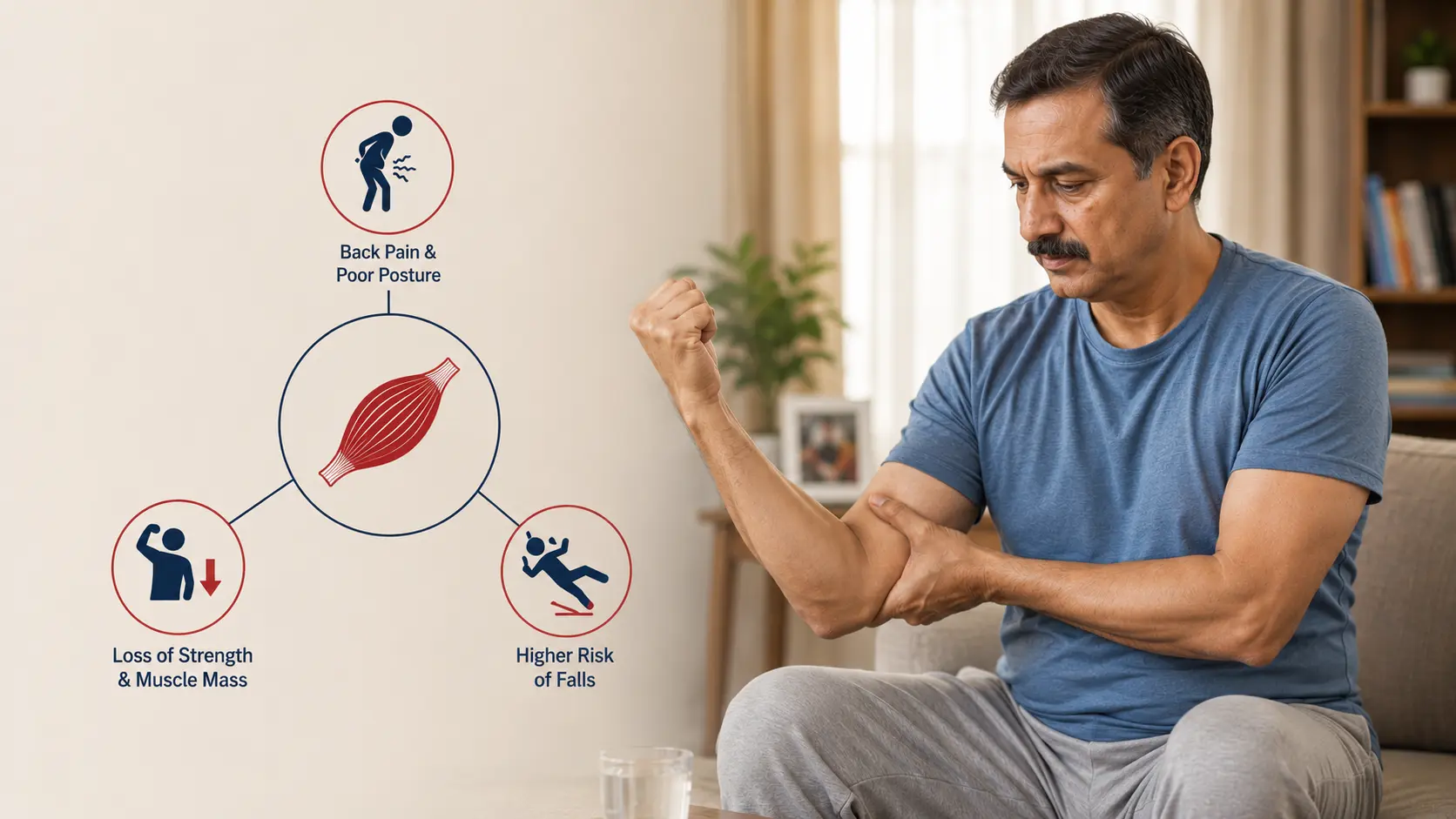
These are not random signs of getting older. They are often the earliest signals of muscle loss with age. It begins earlier than most people expect and becomes harder to ignore with every passing decade.
Why Does Muscle Loss With Age Begin in Your 30s?
Most people associate muscle loss with old age.
But research shows the process starts around age 30, often without any obvious signs. From this point, adults lose roughly 3-5 % of muscle mass per decade. The biology driving this comes down to three shifts happening at once:
- Testosterone and growth hormone levels begin to decline
- The body’s muscle-building signals slow down
- The anabolic response, the ability to build and repair muscle after exertion, becomes less efficient
For most people in their 30s, a desk job, less physical activity, and fewer hours of sleep quietly accelerate what biology has already set in motion. The early loss is small enough to go unnoticed. But it compounds. What feels like low energy in your 30s can become real functional weakness by your 50s if nothing changes.
What Changes After 40 That Make Muscle Loss Harder to Ignore?
This is the decade where muscle loss stops being subtle. Several things happen at once:
- Estrogen and testosterone levels drop more sharply, reducing the rate of protein synthesis
- Nerve signals to muscles begin to weaken, causing muscle fibres to shrink and become inactive
- Anabolic resistance sets in, meaning the body now needs more protein and more stimulus just to produce the same muscle response it managed easily at 30
The effects show up in daily life: stairs feel steeper, jars are harder to open, and balance feels less steady on uneven ground. Here is how that progression maps across each decade.
| Decade | What Happens | What You May Notice |
| 30s | Hormone levels begin declining; anabolic response slows | Low energy, slightly less stamina |
| 40s | Estrogen and testosterone drop more sharply; anabolic resistance begins | Weaker grip, slower recovery |
| 50s | Nerve-to-muscle signals weaken; protein synthesis drops further | Stairs, carrying, and balance all feel harder |
Muscle Loss Slows Down When You Do These Two Things
- Resistance training: Research shows that the body continues to respond to resistance training meaningfully with age. Gains come at a different pace than in younger years, but consistent resistance work, even at home, is enough to make a real difference.
- Protein intake: Protein matters, but only alongside resistance training. Research from Harvard Health confirms that protein alone, without regular resistance work, has limited impact on preserving muscle mass. Combined, the two are significantly more effective than either one on its own.
Consistency matters more than intensity, and strength training for older adults does not have to mean a gym or a complicated programme to make a real difference.
4 Small Signs That Muscle Loss Is Already Happening
- Grip strength feels weaker
- You tire faster on stairs or after short walks
- Recovery from physical exertion takes longer than it used to
- Balance feels less reliable on uneven surfaces or when standing on one leg
These signals are worth paying attention to, but they are not a reason for alarm. Muscle responds to training at any age. Even adults in their 70s show meaningful strength improvements with consistent resistance work.
Recommended Reading:
If you want to help a parent or older family member recognise these signs and start acting on them, this blog on how to help parents stay strong is a good place to start.
Why Do Most Older Adults Never Start Resistance Training?
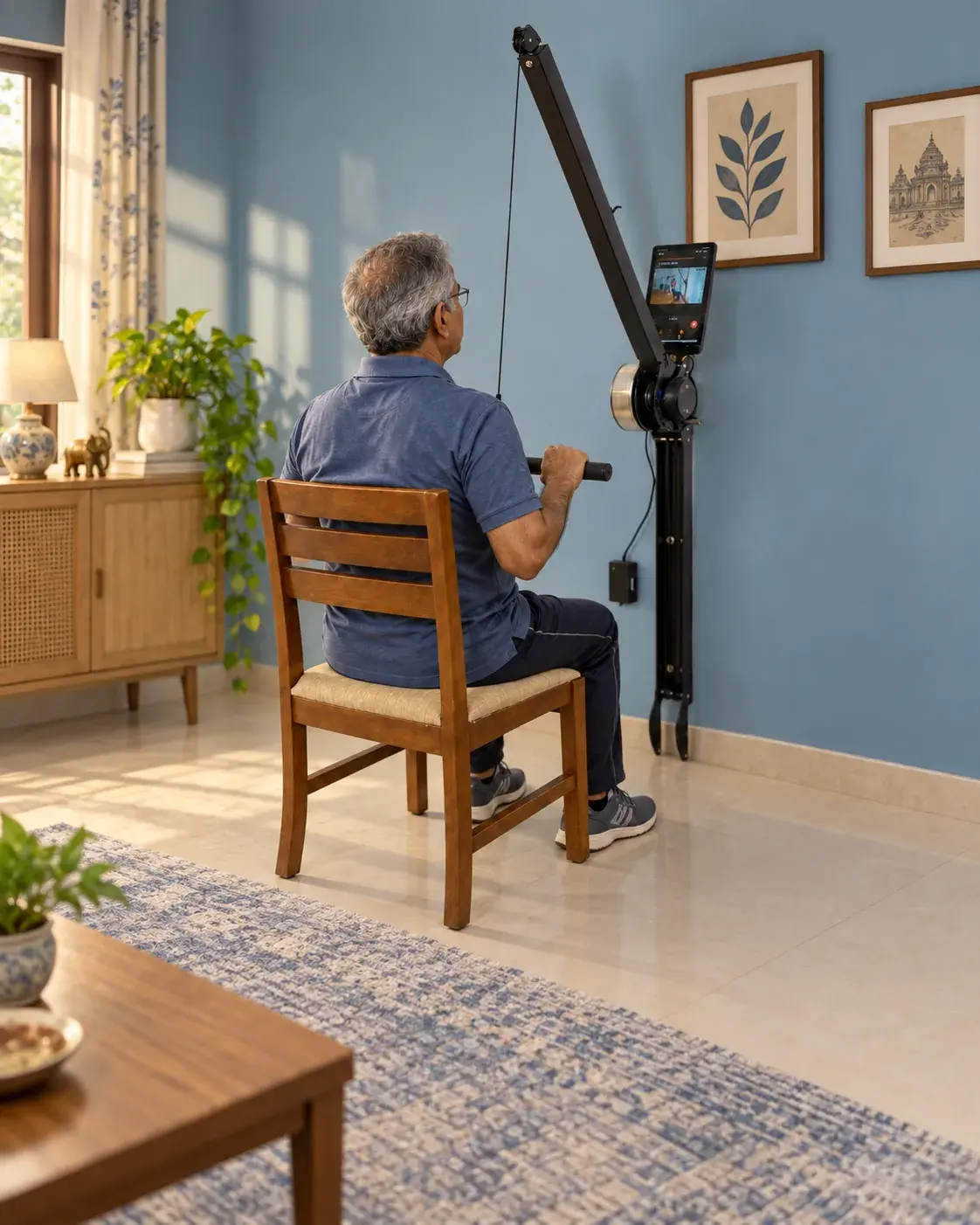
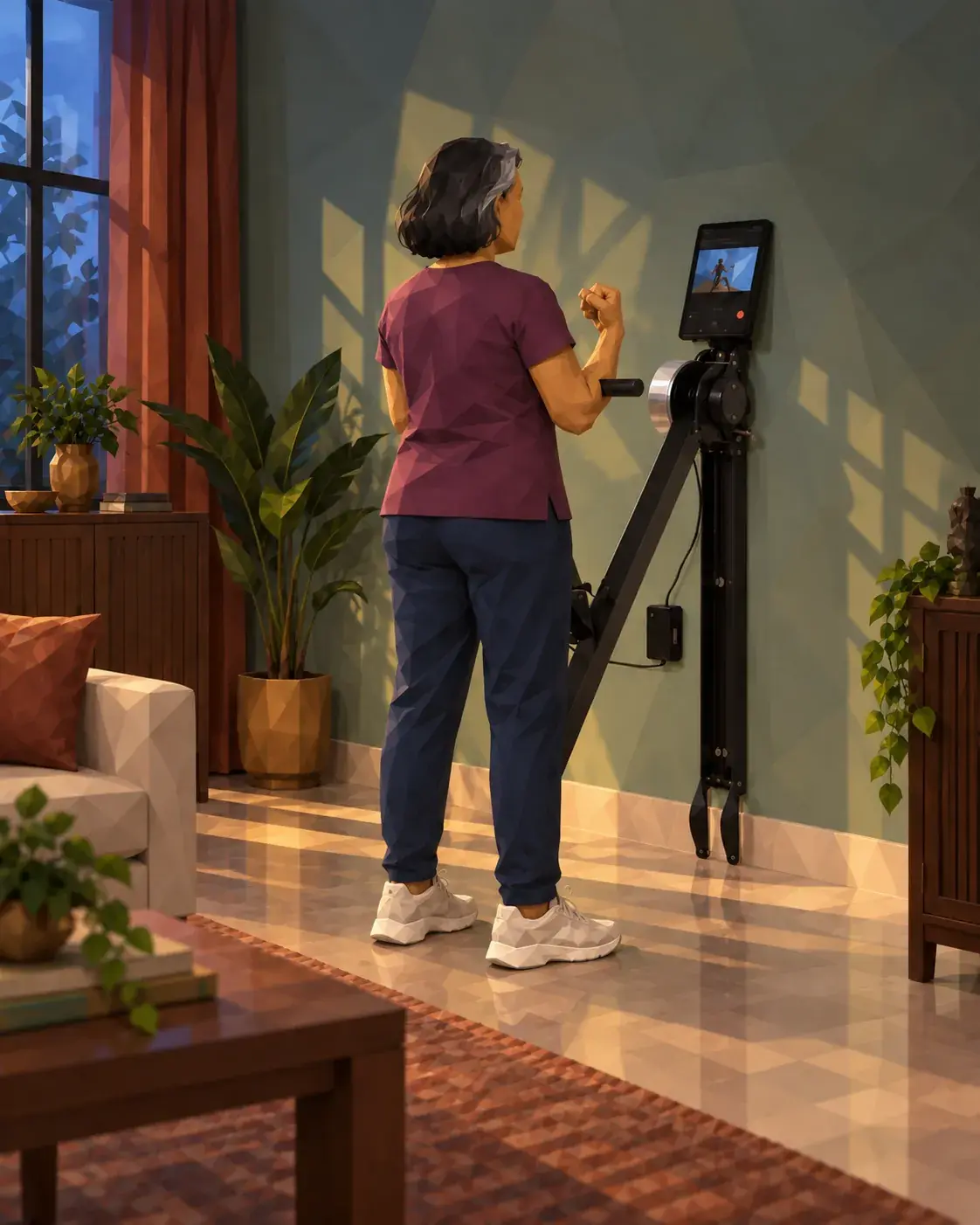
Knowing why muscle loss happens is useful. But for most older adults, the real barrier is finding strength training equipment that is safe, consistent, and practical to use at home without risk of injury or soreness. Ferra was designed specifically to solve that problem.
- Ferra uses concentric-only resistance, meaning the machine gives resistance when you lift or push, but does not load your body on the way down
- The downward phase of exercise is usually what causes muscle soreness and joint strain, and Ferra removes it entirely
- The resistance also adjusts automatically to your current strength level, so there is no guessing, no risk of overloading, and no need for a trainer
See how Ferra makes resistance training safe, simple, and sustainable at home.
Conclusion
Muscle loss with age is gradual. It starts earlier than most people realise, and it is driven by real biological shifts, not just inactivity. But the body remains responsive to training throughout every decade. What you do consistently in your 40s and 50s directly shapes how strong and independent you feel in your 60s and beyond.
The goal is not to reverse time. It is to give your body the stimulus it needs to stay functional, steady, and capable for the life you want to live.
A few months of consistent resistance training can change how stairs feel, how confidently you carry things, and how steady your balance is. That shift is more achievable than most people in their 40s and 50s believe.
Muscle Loss With Age: Frequently Asked Questions
1. Can you rebuild muscle after 50 if you have never trained before?
Yes. Studies show that adults in their 50s, 60s, and even 70s can build meaningful muscle mass and strength with consistent resistance training, even with no prior training history. The rate of progress may be slower than in younger adults, but the gains are real, and the benefits to daily function are significant.
2. How much protein do you actually need to slow muscle loss?
Most research suggests older adults benefit from 1.0 to 1.2 grams of protein per kilogram of body weight per day, which is higher than the standard recommended intake. This amount works best when spread across meals rather than consumed in one sitting, and it needs to be paired with regular resistance training to have a meaningful effect on muscle mass.
3. Is it normal to feel sore after starting strength training at 45 or 50?
Some mild soreness in the first week or two is normal as the body adapts. However, sharp pain in joints, persistent soreness lasting more than three days, or pain during movement are signals to ease off and consult a doctor. Machines like Ferra, which use concentric-only resistance, are designed to significantly reduce soreness risk for older adults by removing the eccentric loading phase that typically causes it.
4. Can women lose muscle faster than men as they age?
Yes. Women tend to experience an accelerated period of muscle loss around menopause, driven by the sharp decline in estrogen. Estrogen plays an important role in protein synthesis and muscle-building signalling, so its reduction can meaningfully speed up the process. This makes starting resistance training before or during menopause especially valuable.
5. What if you have joint pain or a bad knee? Can you still do resistance training?
Yes, with the right approach. Low-impact resistance training that avoids deep joint angles and heavy eccentric loading is generally safe even with knee or hip discomfort, and it often reduces joint pain over time by building the supporting muscle around the joint. It is worth speaking to a doctor before starting if you have an existing diagnosis.
Build everyday strength — at your pace
Explore Ferra to see how strength training fits into life after 50 — it’s not about building muscle for its own sake, but moving with confidence.

Anurag Dani is the Co-Founder of Ferra, a company dedicated to redefining healthy ageing through strength training. Drawing from his experience building fitness and healthy ageing solutions for adults, he writes about healthy ageing to help readers stay strong and independent as they age.