Your balance is declining right now, and you probably have not noticed yet.
Balance does not disappear overnight. It erodes gradually, quietly, while life continues as normal. Most people only notice it once it has already slipped, when something that used to be effortless suddenly requires thought.
The good news is that balance is trainable, and the body responds at any age. A week of the right balance exercises for seniors is enough to feel a shift. This guide shows you exactly how.
Why Balance Gets Harder as You Get Older
Balance is not a single system. It depends on three things working together, and with age, all three start to weaken.
- Muscle loss reduces the strength in the legs and core that hold you upright during every step
- The vestibular system in the inner ear begins declining after middle age, reducing the stability signals your brain receives
- Proprioception slows down, meaning the automatic micro-corrections your body used to make without thinking now take a fraction of a second longer
That fraction of a second is often the difference between catching yourself and falling. The encouraging part is that all three systems respond to training at any age.
3 Safety Rules Before You Start Your Balance Training
- Keep a wall, sturdy chair, or kitchen counter within arm’s reach. Not to lean on constantly, but to have something there if you lose your footing
- Move slowly and deliberately through each exercise. Balance training works by challenging your nervous system, and speed defeats that purpose
- Stop immediately if you feel sharp pain or persistent dizziness, and speak with your doctor before resuming
Recommended Reading:
If you are looking for a broader starting routine alongside these exercises, these exercises for seniors at home follow the same approach and require no equipment.
5 Balance Exercises Seniors Should Do Every Single Day
1. Single-Leg Stand

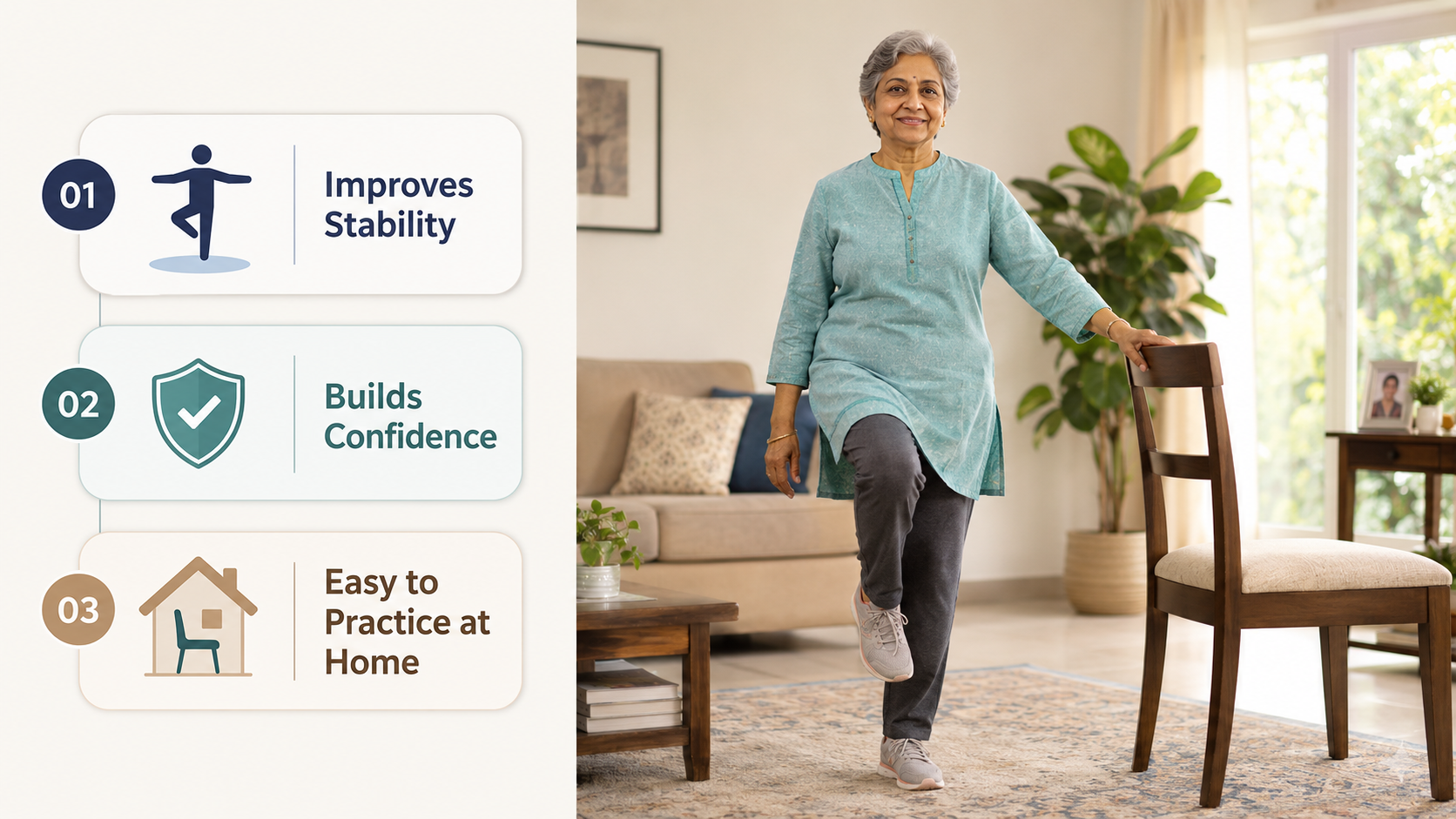
Stand behind a sturdy chair with both hands resting lightly on the back. Lift your right foot a few inches off the floor, keeping your left knee soft. Hold for 10 seconds, then switch. Work up to 30 seconds on each side over the week. This targets the ankle stabilisers and the muscles along the outer hip that prevent sideways swaying.
2. Heel-to-Toe Walk

Stand tall with arms slightly out at your sides. Place your right heel directly in front of your left toes and continue for 20 steps in a straight line. Walk slowly and near a wall if needed. This trains the coordination between your feet and your brain that walking on uneven ground demands.
3. Sit-to-Stand

Sit on a firm chair with feet flat on the floor, hip-width apart. Lean slightly forward and rise to standing without using your hands, then lower yourself back down slowly and with control. Do 10 repetitions. This strengthens the thighs and glutes, the primary muscles that absorb the load every time you get up from a seat or step off a surface.
4. Marching in Place

Stand near a counter with fingertips resting lightly on it. Lift your right knee to hip height, lower it, then lift your left. Continue for 20 alternating lifts at a steady pace. This builds hip flexor strength and trains your body to manage weight shifts, which is what balance during walking actually requires.
5. Calf Raises

Stand behind a chair with your hands resting on the back. Rise slowly onto the balls of both feet, hold for two seconds at the top, then lower back down with control. Do 15 repetitions. The calf muscles and ankles are your last line of defence when you stumble, and keeping them strong is one of the most practical things you can do for everyday steadiness.
Together, these five exercises cover both coordination training and targeted strengthening, which is what makes them work as a system rather than in isolation.
Your First Week of Balance Training: A Day-by-Day Plan
- Days 1 and 2: Choose two or three of the exercises above. Use your chair or wall support freely and focus entirely on slow, controlled movement
- Days 3 and 4: Add the remaining exercises. Where you feel stable, try reducing your grip on the chair to fingertips only, rather than a full hold
- Days 5 to 7: Move through all five in sequence. Notice whether your single-leg hold time has improved and whether the heel-to-toe walk feels more automatic. These small shifts are real neurological progress
Short daily sessions do more than longer sessions done twice a week. Balance is a nervous system skill, and it improves through repetition. Consistency is the whole strategy.
It is also worth knowing that balance exercises have a ceiling. They train your coordination and reactions, but if the muscles underneath are too weak, that coordination has very little to work with. Strength in the legs and core is what prevents muscle loss from quietly eroding the foundation your balance depends on. Pairing balance drills with regular leg and core strengthening gives both systems a chance to support each other.
Why Strength Is the Foundation of Balance for Seniors
Balance training improves coordination and sharpens your nervous system’s reflexes. But coordination can only do so much when the muscles supporting each movement are not strong enough to respond. The legs, hips, and core need to be genuinely capable of the work before balance drills can produce their full effect.
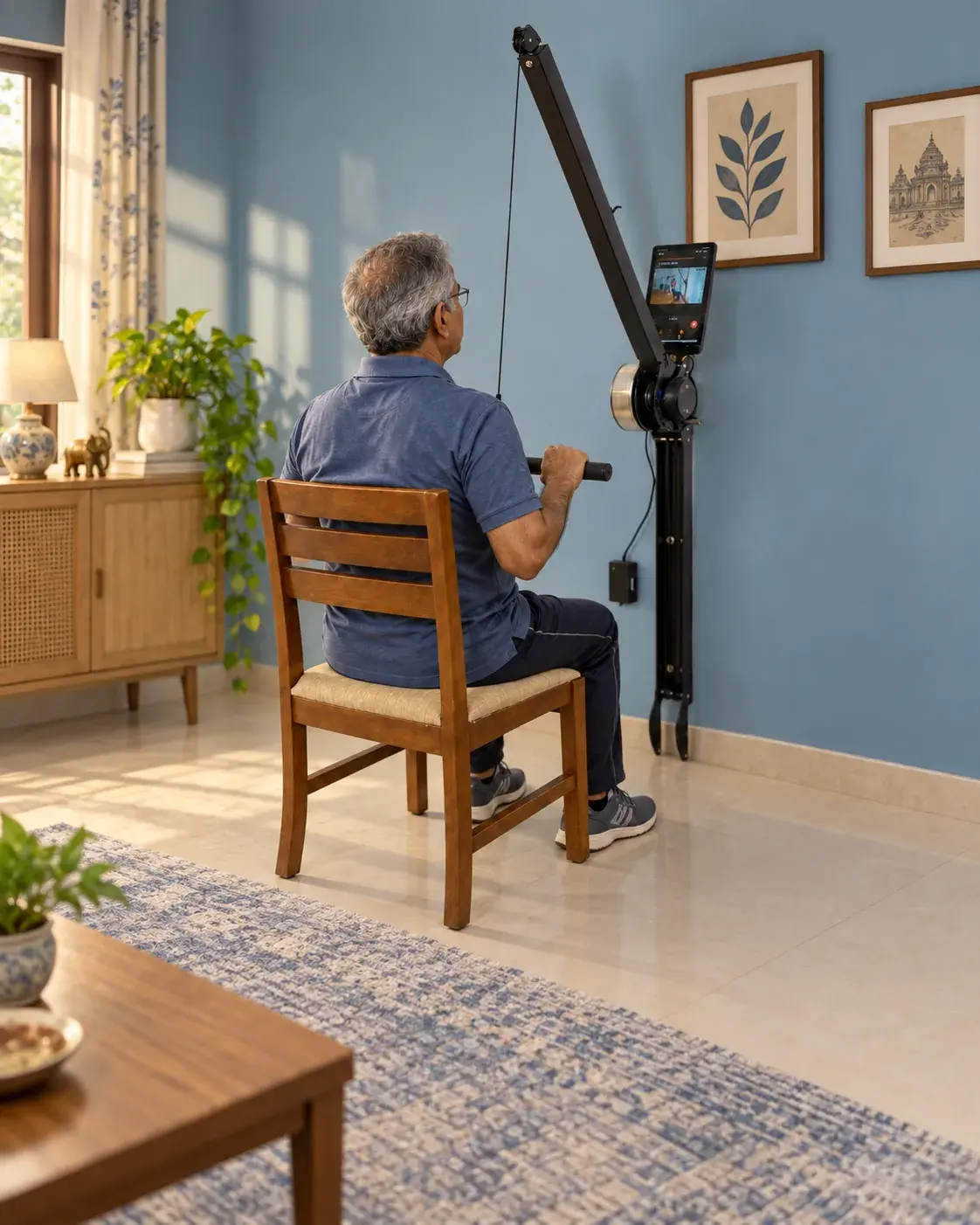
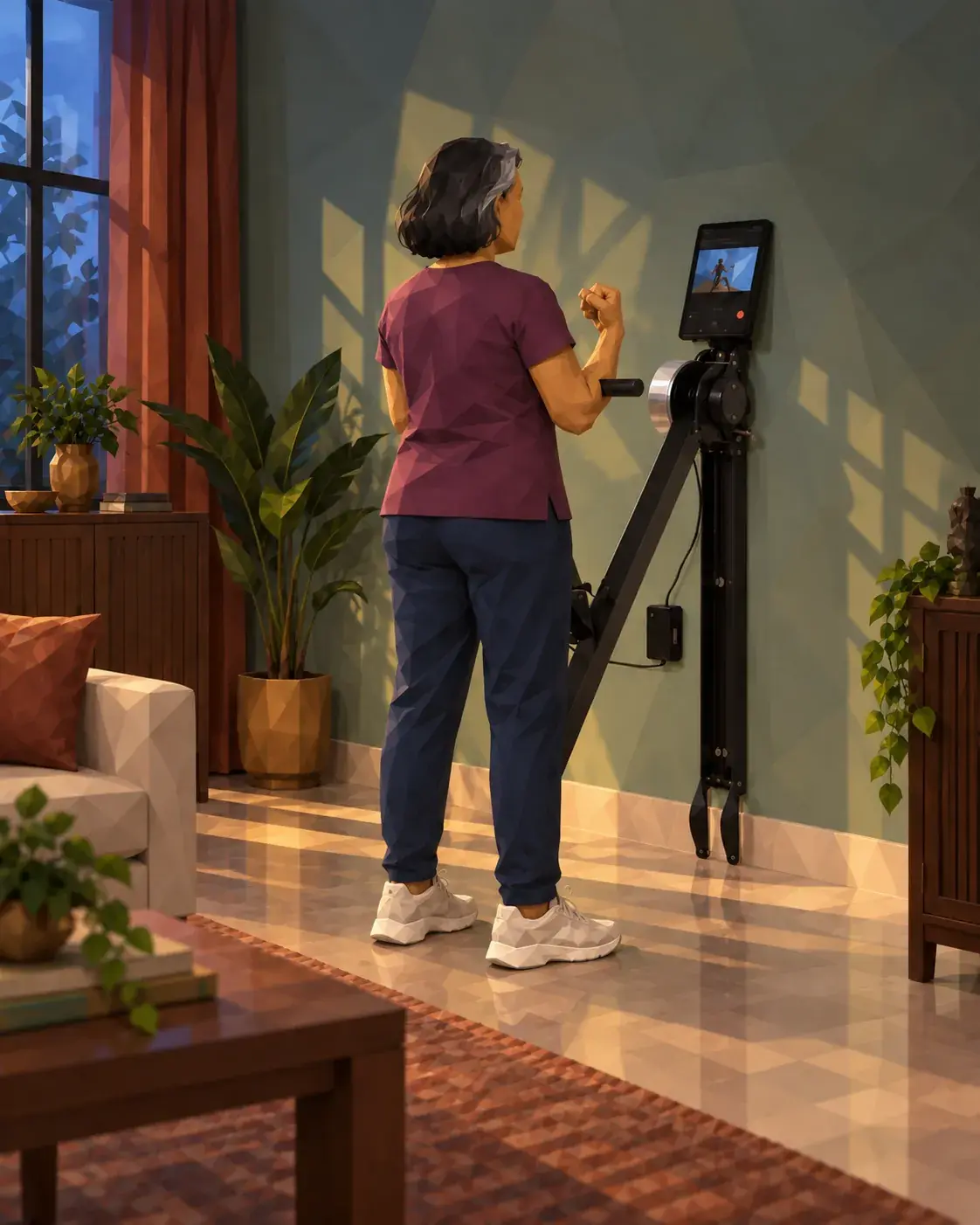
That muscle foundation is what strength training equipment for seniors, like Ferra, is built to develop:
- Concentric-only resistance: The machine resists your effort but never loads you on the way down. Think of it like pushing a car. The moment you stop pushing, there is no weight bearing down on you.
- Auto-adjusting load: Resistance adapts to your current strength, so there is no risk of overloading a joint.
Try Ferra today and build the leg and core strength your balance depends on.
Conclusion
Balance is a trainable skill. The body responds to consistent daily effort at any age. The changes start small and build steadily. A few weeks of practice, and movements that once felt uncertain may stop requiring any thought at all.
Balance Exercises for Seniors: Frequently Asked Questions
1. How often should seniors do balance exercises?
Daily practice gives the best results. Balance is a nervous system skill, and frequency matters more than duration. Ten to fifteen minutes a day is enough.
2. Can balance exercises be done with knee or hip pain?
Yes, with adjustments. Reduce the range of motion or use chair support throughout. If pain is significant or recurring, speak with a physiotherapist before starting.
3. Is balance training different from strength training, and are both necessary?
Yes, they are different. Balance exercises train coordination and nervous system responses. Strength training builds the muscle that those responses rely on. Doing only one without the other limits how far you can progress. Machines like Ferra, which use concentric-only resistance, are designed specifically to build leg and core strength without putting joints under strain.
4. How long before real improvement in balance shows up?
Most people notice something within five to seven days, typically a longer hold time in the single-leg stand or more confidence in the heel-to-toe walk.
5. What should be done if dizziness occurs during these exercises?
Stop immediately and sit down. Persistent or severe dizziness may indicate an inner ear issue or a medication side effect. Speak with your doctor before continuing.
Build everyday strength — at your pace
Explore Ferra to see how strength training fits into life after 50 — it’s not about building muscle for its own sake, but moving with confidence.

Anurag Dani is the Co-Founder of Ferra, a company dedicated to redefining healthy ageing through strength training. Drawing from his experience building fitness and healthy ageing solutions for adults, he writes about healthy ageing to help readers stay strong and independent as they age.