Why do some falls end in a fracture, and others in just a bruise?
It usually comes down to bone strength, and most find out only after it’s too late.
This is especially true in India, where vitamin D deficiency and sedentary routines are common, and bone density tends to drop earlier than people expect.
A community screening study in India found that nearly 69% of adults above 50 had low bone mineral density, either osteopenia or osteoporosis. In this article, we will look at the exercises to improve bone density that can close this gap and help the body rebuild what age has quietly taken away.
Bone Density Starts Dropping Silently After 40
Bone is living tissue. It breaks down and rebuilds continuously throughout life. But after 40, this balance starts to tip, and the body breaks down bone faster than it can replace it.
The areas most affected first are:
- Lumbar spine: lower back vertebrae, responsible for posture and daily load
- Femoral neck: the top of the thigh bone, where most hip fractures begin
- Wrist and forearm: often the first fracture site after a fall
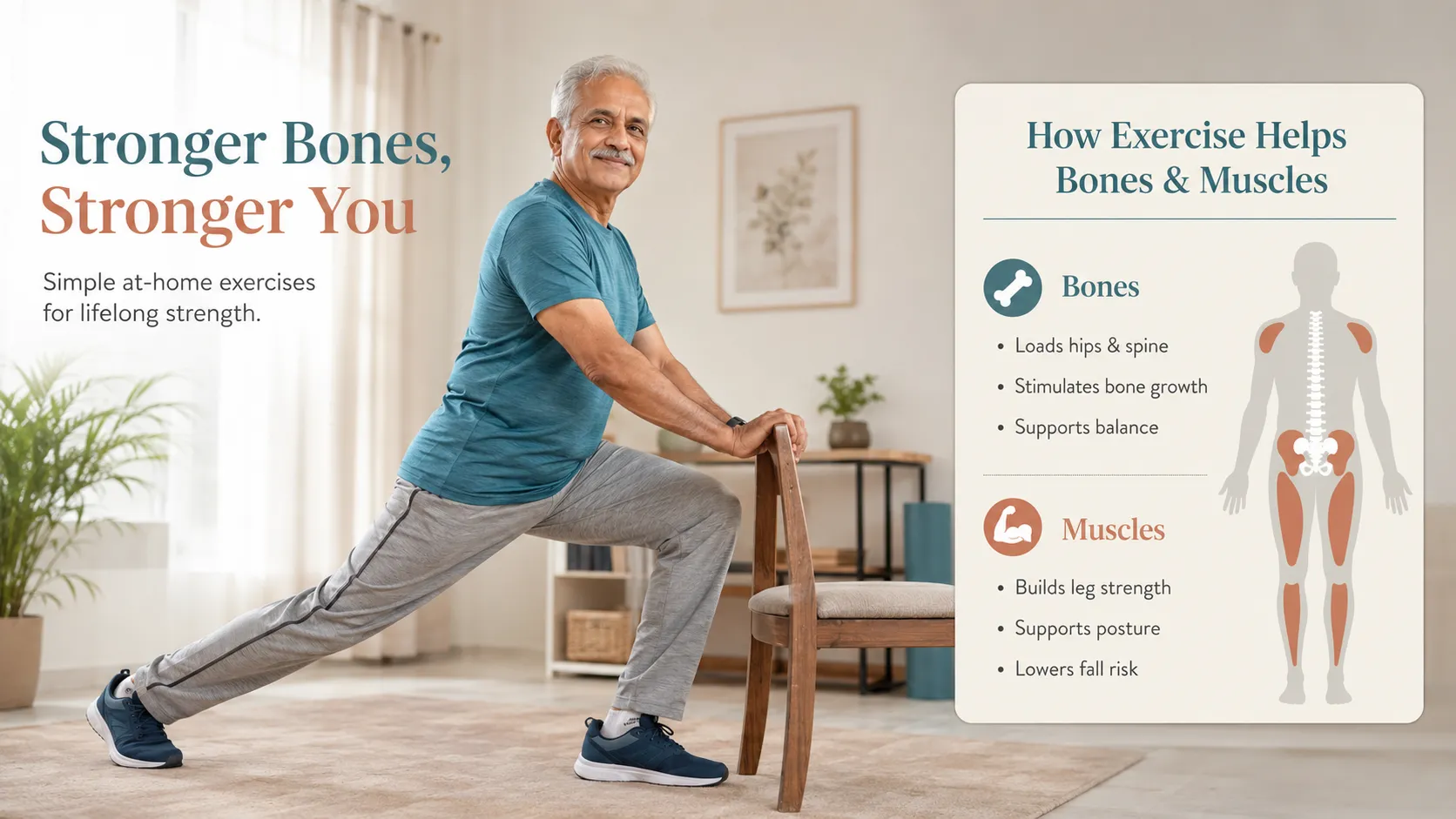
Most people associate bone health with calcium alone. Nutrition matters, but it is not enough on its own. Bones need mechanical load, the kind muscles place on them during resistance exercise, to keep producing new tissue. The good news is that it is never too late to start. Beginner strength training at any age can still lead to meaningful gains in bone strength. Waiting until there is pain only means waiting too long.
The Science Behind Exercise and Bone Strength
When a muscle contracts against resistance, it pulls on the bone it is attached to. This pull sends a direct mechanical signal to your skeleton, triggering specialized bone-forming cells called osteoblasts to step in and build new, denser bone tissue. This is the basic mechanism behind every exercise to improve bone density.
But not all exercise creates this stimulus equally. The American Academy of Orthopaedic Surgeons notes that heavier resistance with lower repetitions produces a much stronger bone-building signal than lifting light weights for high reps. While any form of resistance training helps, a heavier load simply works faster to stimulate new growth.
Here is how different types of exercise stack up:
| Exercise Type | Bone-Building Stimulus | Notes |
| Resistance training | High | Directly loads bones through muscle pull |
| Brisk walking | Moderate | Weight-bearing but limited load |
| Swimming/cycling | Very low | Non-weight-bearing; good for joints, not bones |
| Yoga/stretching | Low | Useful for balance; minimal bone stimulus |
The exercises in the next section are built around this principle: load the muscles, load the bones.
Recommended Reading:
If building a consistent strength habit feels unfamiliar, these exercises for seniors at home are a practical place to start.
5 At-Home Exercises to Improve Bone Density for Seniors
These five exercises target the spine, hips, and upper body, the regions most vulnerable to bone loss with age. They are designed to be done safely at home, with a chair or wall for support where needed.
1/ Chair Squats
Stand in front of a sturdy chair with feet hip-width apart. Bend the knees and push the hips back, lowering slowly as if sitting down, then stop just before touching the chair and rise back up.
- Aim for 3 sets of 10 to 12 reps
- Keep weight on the heels, not the toes
- Hold the back of the chair lightly for balance if needed
This loads the hips and thighs, two areas where strength loss directly increases fracture risk after a fall.

2/ Wall Push-Ups
Stand facing a wall, arms extended at shoulder height, palms flat against it. Bend the elbows to bring the chest toward the wall, then push back to the start position.
- Aim for 3 sets of 10 to 12 reps
- Keep the body in a straight line from head to heels
- Move slowly on both the push and the return
This loads the wrists, forearms, and shoulders, areas that are common fracture sites when a fall is broken by an outstretched hand.

3/ Seated Resistance Band Row
Sit upright in a chair with a resistance band looped around a stable anchor in front of you. Hold one end in each hand and pull both elbows back, squeezing the shoulder blades together, then release slowly.
- Aim for 3 sets of 10 to 12 reps
- Keep the spine tall throughout, avoid slouching
- Control the release; do not let the band snap back
This strengthens the mid-back and counters the forward slouch that places uneven pressure on the spine over time.

4/ Standing Marching with Light Weights
Stand tall, holding a light weight in each hand or simply at the sides. Lift one knee toward hip height, lower it, then repeat with the other leg, as if marching in place.
- Aim for 3 sets of 12 to 15 reps per leg
- Hold onto a counter or chair if balance feels unsteady
- Keep movements slow and controlled rather than fast
This builds hip and leg strength while doubling as a balance exercise, which helps prevent the falls that most often lead to fractures.

5/ Seated Overhead Press
Sit upright in a sturdy chair with a light weight or resistance band handle in each hand at shoulder height. Press both arms slowly overhead, then lower with control.
- Aim for 3 sets of 8 to 10 reps
- Keep the core engaged to support the lower back
- Avoid arching the back as the arms rise
This loads the shoulders and upper spine, helping maintain bone strength in the upper body where posture-related fractures are common.
These five exercises cover the hips, spine, and upper body, the three regions where bone loss creates the most serious long-term consequences, including fractures from minor falls.

Exercises to Improve Bone Density Need Progressive Resistance
The exercises above work because they load the bones, but the amount of load matters just as much as the movement. Bodyweight and bands are a safe starting point, yet bone gains slow down without progressively heavier resistance. At home, this creates a real problem:
- Free weights are hard to size correctly without guidance
- Increasing resistance manually raises the risk of strain
- Most people stay at the same light load for months, capping further gains
What the body needs is resistance that increases safely as strength improves, without the guesswork. Strength training equipment for seniors, like Ferra, is built around this need. It uses concentric-only resistance, so the machine pushes back against your effort but never loads you on the way down, removing the phase most responsible for soreness and strain. It also adjusts automatically within each set, so the muscles, and the bones they pull on, are challenged safely every time.
Check out Ferra and build the bone-supporting strength your body needs at home.
Conclusion
Bone density loss is slow, and reversing it is slow too. There is no single workout that fixes it, only consistent resistance training done over time.
Start with movements you can do safely, add load gradually, and stick with it daily. Nothing will change overnight, but the effort adds up, and a few months from now, your bones will be stronger for it.
Exercises to Improve Bone Density: Frequently Asked Questions
1/ How long does it take for resistance exercise to improve bone density?
Measurable changes in bone mineral density typically take 4 to 6 months of consistent resistance training. Progress is gradual, but studies show that even older adults can see meaningful improvement with regular load-bearing exercise over time.
2/ Can someone with osteoporosis do these exercises safely?
Yes, with modifications. Exercises like seated rows and lat pulldowns are generally safe even for those with low bone density. Deadlifts and squats should be started with very light resistance and ideally with guidance from a physiotherapist to ensure correct form.
3/ Is walking enough to maintain bone density after 50?
Walking helps slow bone loss but is typically not sufficient on its own to build bone density. It provides moderate weight-bearing stimulus, mainly for the legs and hips. For meaningful bone-building effects, resistance training needs to be added to a walking routine.
4/ Do these exercises need to be done daily?
Consistency is what matters most. Short, regular sessions carried out most days are more effective for bone health than longer sessions done once or twice a week. The bone-building signal from resistance exercise fades if sessions are too infrequent.
5/ Are there home-based options for seniors who cannot use free weights?
Yes. Resistance bands, bodyweight exercises, and home fitness equipment designed for older adults can all deliver meaningful bone stimulus without the risks of heavy free weights. Equipment like Ferra uses electronically controlled resistance that adjusts automatically, removing the need to manually load or calibrate weights.

Anurag Dani is the Co-Founder of Ferra, a company dedicated to redefining healthy ageing through strength training. Drawing from his experience building fitness and healthy ageing solutions for adults, he writes about healthy ageing to help readers stay strong and independent as they age.