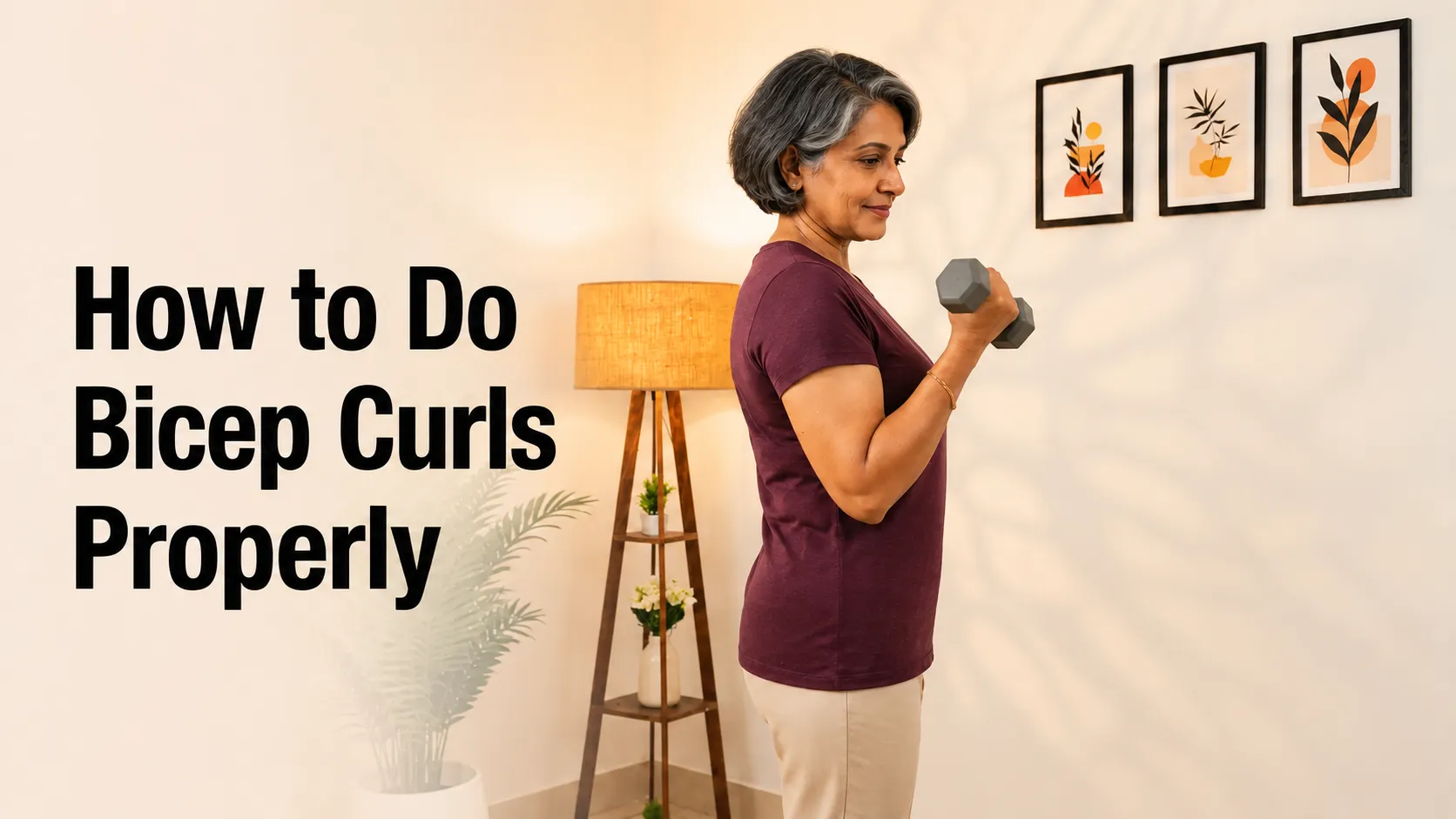
Carrying a bag of groceries, lifting a heavy pot, pulling open a stubborn door. These are movements the body does dozens of times a day without much thought, but they get harder with age.
- Arms tire faster than they used to
- Every day objects start to feel heavier
- Simple lifting tasks need more effort to complete
Understanding how to do bicep curls properly is one of the most practical steps you can take to reverse that pattern.
Why Bicep Strength Matters More as You Get Older
The bicep muscle sits at the front of the upper arm. Its job is simple: bend the elbow and lift. Muscle mass decreases with age, and research by Jones and Rikli in the Journal on Active Aging established that upper-body strength is directly tied to independence in older adults.
This shows up in tasks like:
- Carrying groceries without struggling halfway through
- Lifting luggage on and off a shelf
- Picking up something heavy without bracing first
For older adults, this is not about appearance. It is about keeping daily tasks from becoming unnecessarily difficult. When bicep strength declines, the rest of the upper body compensates, which is how bad posture and shoulder tension begin.
Recommended Reading:
If you are just getting started, these beginner strength training tips for older adults walk through how to build a simple, safe routine at home.
Seated vs. Standing: Which Should You Start With?
| Seated | Standing | |
| Balance required | Low | Moderate |
| Core involvement | Lower | Higher |
| Risk of back sway | Minimal | Moderate if weight is too heavy |
| Best for | Complete beginners | Those with some baseline stability |
Seated curls are the safer starting point. Move to standing once you can complete 10 reps with full control and no discomfort.
How to Do Seated Bicep Curl?
Sit upright in a sturdy chair with your feet flat on the floor. Hold a weight in each hand with arms at your sides and palms facing forward.
- Keep elbows tucked close to your sides
- Curl the weights up slowly toward your shoulders
- Pause briefly at the top, then lower with control
Do 8 to 10 reps per set, starting with 1 to 2 sets. The seated position removes balance from the equation, so all the effort goes into the muscle itself.
How to Do Standing Bicep Curl?
The movement is identical to the seated version, with one difference: your core now has to work to keep the torso still.
- Stand tall with feet shoulder-width apart, knees soft
- Brace your core to prevent any rocking or swaying
- Follow the same curl, pause, and controlled lower
Move to standing only once the seated curl feels fully controlled. The added stability demand is what makes this the natural next step, not a separate exercise to learn from scratch.
Pro Tip:
Once you complete 10 clean reps for two sessions in a row with no strain, move up slightly in weight.
Three Form Mistakes That Reduce Results and Risk Injury
Getting the movement right matters more than how much you lift. These three mistakes are the most common and the most damaging for older joints.
1/ Swinging with momentum
Rocking the torso to get the weight up takes the load off the bicep and puts it on the lower back. If you need to swing to finish a rep, the weight is too heavy.
2/ Elbows drifting forward
When the elbows move in front of the body, the shoulder takes over and the bicep does less work. Keep the elbows pinned at your sides the whole time.
3/ Rushing the lowering phase
The downward part of the curl is where most joint strain happens. Lower the weight over 2 to 3 seconds instead of letting it drop. This keeps the muscle in control and protects the elbow.
Fixing these three things makes the curl safer and more effective. Clean form means the muscle does more work, so you need less weight to get the same benefit.
Recommended Reading:
Wondering what else you can do safely at home besides curls? These exercises for seniors at home follow the same slow, controlled approach.
How to Do Bicep Curls Properly Requires More Than the Right Weight
Doing the curl correctly is one part of the picture. The other part is what happens on the way down, and that is where traditional dumbbells fall short. With a regular weight, the lowering phase loads the joint just as much as the lift, sometimes more. For older adults with joint sensitivity, this is usually where soreness and strain begin.
This is exactly what strength training equipment for seniors, like Ferra, is built to remove:
- The machine resists your effort on the way up
- It applies no load at all on the way down
- Resistance is digitally controlled, so you never start too heavy
- It calibrates automatically to your current strength level
The result is a curl that builds strength without the part of the movement that usually causes the strain. Check out Ferra and build the arm strength that makes daily lifting easier without the joint strain.
Conclusion
Bicep curls reward correct form faster than they reward heavy weight. Keep the elbows still, lower with control, and start lighter than your ego wants to. That is the whole skill.
Stay consistent with it for a few weeks and the change shows up exactly where you need it most: groceries that no longer feel like a fight, jars that twist open on the first try, a grandchild you can lift without thinking twice. That is what real arm strength buys you, and it is built one controlled rep at a time.
How to Do Bicep Curls Properly: Frequently Asked Questions
Can older adults do bicep curls if they have elbow or wrist pain?
It depends on the cause of the pain. Mild joint stiffness is usually not a barrier, and light-weight curls done slowly can actually support joint health over time. However, if the pain is sharp, shooting, or worsens during the movement, it is worth consulting a doctor before continuing.
Are resistance bands a good alternative to dumbbells for bicep curls?
Yes. Resistance bands provide tension throughout the entire range of motion and are often gentler on the wrists and elbows than dumbbells. They are a practical option for beginners or anyone returning to exercise after a break.
Is it better to curl both arms at the same time or one at a time?
Either works. Alternating arms allows you to focus on each side individually, which can help correct imbalances. Curling both arms together adds a core stability challenge. Beginners typically find alternating easier to control.
How long before bicep curls produce noticeable results?
Most people notice a difference in strength within 3 to 4 weeks of regular training, although visible changes in the muscle take longer. The more meaningful early sign is that daily tasks start feeling easier.

Anurag Dani is the Co-Founder of Ferra, a company dedicated to redefining healthy ageing through strength training. Drawing from his experience building fitness and healthy ageing solutions for adults, he writes about healthy ageing to help readers stay strong and independent as they age.