Why does standing up from a chair suddenly need more effort than it used to?
It is usually a sign that the lower body, the quads, hamstrings, and calves, is losing strength faster than the rest of the body. Left unaddressed, everyday movement slowly turns into daily effort instead of something you do without thinking.
In this article, we cover why this happens and walk through 5 simple lower body exercises for seniors using ankle weights that you can do at home to rebuild that strength, safely and at your own pace.
Are Ankle Weights Safe for Seniors at Home?
Yes, with one distinction: ankle weights work well for controlled, stationary exercises, not for walking or cardio. Worn during movement, they alter your gait and add stress to the ankle and knee joints.
For seated and standing isolation exercises, though, they are well-suited for older adults. A few ground rules make them safer:
- Start at 0.5 to 1 kg per ankle
- Add reps before adding weight
- Stop if there is sharp pain or joint swelling
Recommended Reading:
If knee discomfort is already part of the picture, pairing this with targeted knee osteoarthritis exercises can help build stability around the joint alongside this routine.
5 Lower Body Exercises for Seniors Using Ankle Weights
The following are lower body exercises for seniors that cover the major muscle groups with no high-impact movement required.
| Exercise | Muscle Targeted | Position |
| Seated Leg Extension | Quadriceps | Seated |
| Seated March | Hip Flexors | Seated |
| Standing Side Leg Raise | Outer hips, glutes | Standing |
| Standing Hamstring Curl | Back of thigh | Standing |
| Standing Calf Raise | Calves | Standing |
1/ Seated Leg Extension
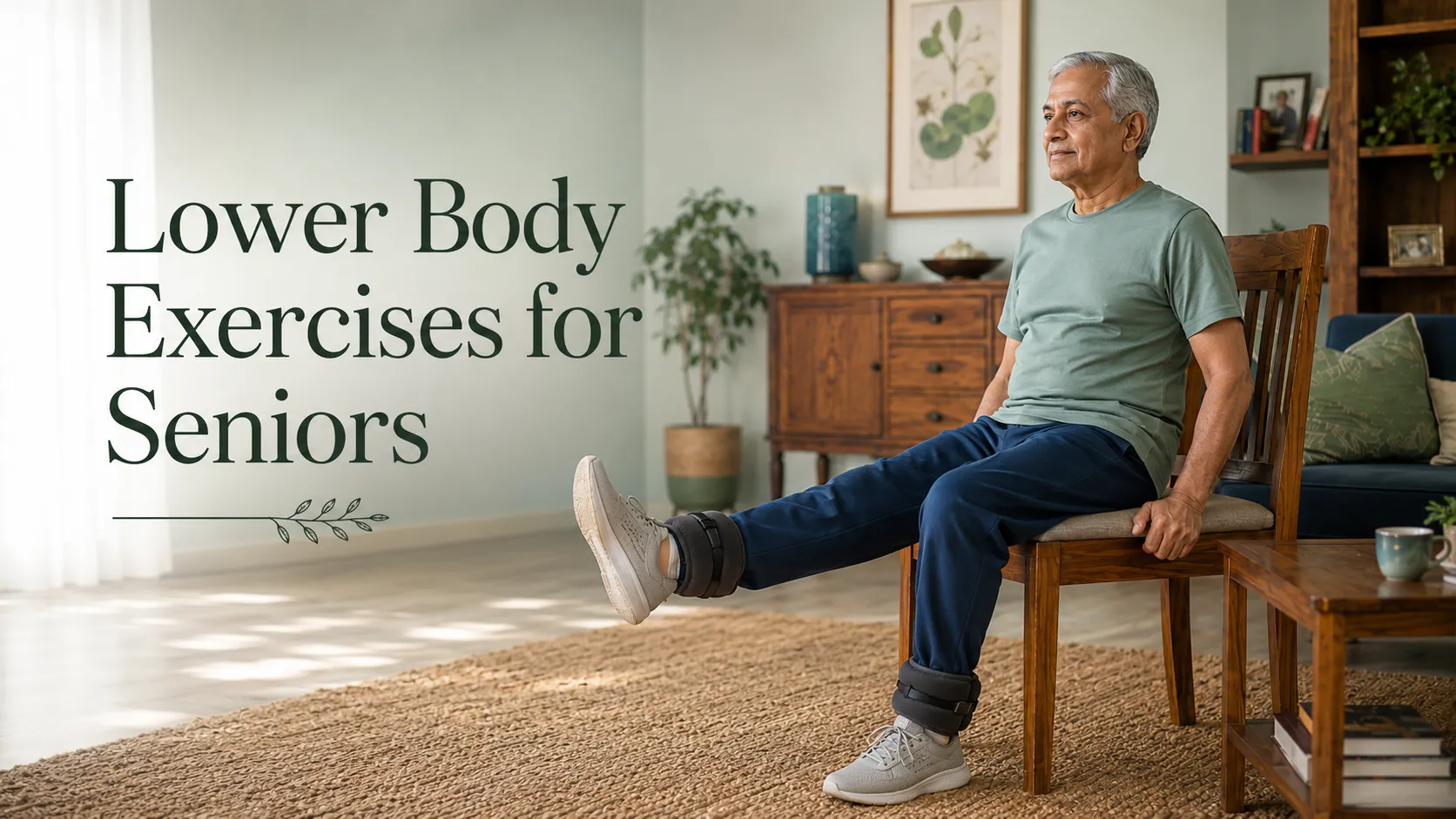
Sit upright with feet flat and ankle weights secured. Extend one leg straight to hip level, hold two seconds, then lower with control. Do 10 to 12 reps per leg for two sets. This targets the quadriceps, the muscles that do the most work when rising from a chair.

2/ Seated March (Hip Flexors)
Sit upright with feet flat and ankle weights secured. Keeping your knee bent, lift one thigh a few inches off the chair, hold briefly, then lower with control. Do 10 to 12 reps per leg for two sets. This strengthens the hip flexors, which are essential for lifting your feet safely over steps and curbs.

3/ Standing Side Leg Raise
Stand behind a chair holding the backrest. Lift one leg straight out to the side, then lower with control. Do 10 to 12 reps each side for two sets. This strengthens the outer hips and glutes, which support side-to-side balance.

4/ Standing Hamstring Curl
Stand behind a chair. Bend one knee and bring the heel toward the back of your thigh, hold briefly, then lower. Do 10 reps each side for two sets. This builds strength in the back of the thigh and reduces the load on the knee while walking.

5/ Standing Calf Raise
Stand tall behind a chair, holding the backrest for balance. Slowly lift both heels as high as comfortable to balance on the balls of your feet, hold for two seconds, then lower slowly. Do 12 to 15 reps for two sets. This strengthens the calves and ankles, which directly improves everyday balance.
Together, these lower body exercises for seniors work the quads, hamstrings, glutes, and calves, the muscle groups that carry the most load in daily movement.

Recommended Reading:
If hip mobility is also a concern alongside strength, pairing these with hip pain exercises for seniors can address both at once.
How to Build a Consistent Routine at Home
These exercises work best through repetition, not intensity. A short daily session does more than a longer one done occasionally.
- Start without weights for the first few sessions to learn the movements
- Add ankle weights once the form feels natural and controlled
- Work through all five exercises in one session, around 20 minutes
Resistance exercises for seniors do not need to be heavy to be effective. What keeps daily tasks manageable over time is simply showing up.
Recommended Reading:
If you want a broader set of home exercises to pair with this routine, these exercises for seniors at home use the same low-impact, consistent approach.
Lower Body Exercises for Seniors Need a Strength Foundation That Holds
Ankle weights are a practical starting point, but they have a ceiling. Once you work through the heavier options, there is little resistance left to progress to, and the muscles stop being challenged in new ways.
What lower body training really needs at this stage is resistance that keeps adjusting as strength improves. That progressive resistance is what strength training equipment for seniors like Ferra is built around:
- Concentric-only resistance, so the machine works against your effort on the way up but applies no load on the way down
- No risk of being loaded through a movement you cannot control
- Resistance that adjusts automatically to your current strength level during each set
Check out Ferra and build the lower body strength that keeps daily movement feeling easy.
Conclusion
Lower body strength is what keeps daily life manageable. It shows up in standing up without a struggle, walking with confidence, and moving through the day without a second thought.
The lower body exercises for seniors covered in this article ask for nothing more than ankle weights and a chair, and they work because of consistency, not intensity. Start light, build slowly, and stay with it.
A few weeks from now, the difference will show up exactly where it matters most, in how naturally your legs carry you through the day.
Lower Body Exercises for Seniors: Frequently Asked Questions
1/ Can seniors use ankle weights every day?
No, it is best to use them on alternate days. Even with light weights, your muscles and joints need a day of rest between sessions to recover and grow stronger.
2/ How heavy should ankle weights be for seniors starting out?
Start at 0.5 kg per ankle. This creates real resistance in controlled movements like leg extensions and calf raises without overloading the joints. Progress to 1 kg once all reps feel comfortable, then increase gradually.
3/ Is it safe to do these exercises with knee pain?
It depends on the type and cause. Seated leg extensions, calf raises, and side leg raises are generally well-tolerated since they do not place deep pressure on the knee joint. If a doctor has advised avoiding knee loading, checking first is the safer route.
4/ How long before lower-body exercises show results for seniors?
Most older adults notice functional improvements like easier chair stands and less fatigue on stairs within four to six weeks of consistent training. Consistency matters far more than how long each session lasts.
5/ Is ankle weight training better than resistance bands for seniors?
Both are effective for different movements. Ankle weights work well for seated leg exercises where the weight hangs freely, while bands offer more variety for standing positions. Equipment like Ferra, which uses digitally adjustable resistance, offers a way to keep progressing once either tool reaches its limit.

Anurag Dani is the Co-Founder of Ferra, a company dedicated to redefining healthy ageing through strength training. Drawing from his experience building fitness and healthy ageing solutions for adults, he writes about healthy ageing to help readers stay strong and independent as they age.