Why do joints get stiffer with age, even in people who stay active?
As the body ages, synovial fluid production drops, cartilage thins, and ligaments lose their flexibility. The stiffness that follows is not dramatic at first. It shows up in small things:
- A shoulder that does not lift as high as it used to
- Ankles that feel tight on morning walks
- Hips that feel stiff when standing up from a chair
Left alone, it compounds. But research consistently shows that daily movement slows and reverses much of this decline. In this article, we cover five range-of-motion exercises for the elderly that target the joints where stiffness causes the most trouble.
5 Range of Motion Exercises for Elderly to Do Daily
| Exercise | Joint Targeted | Daily Function It Supports |
| Shoulder Circles | Shoulder | Reaching, lifting overhead |
| Seated Hip March | Hip | Walking, stair climbing |
| Ankle Circles | Ankle | Balance, steady walking |
| Knee Extension | Knee | Standing up from a chair |
| Neck Side Tilt | Cervical spine | Turning head while walking |
1/ Shoulder Circles
Sit upright in a chair with both feet flat on the floor. Slowly roll both shoulders forward in a circle, then reverse the direction. Keep the movement smooth throughout. Do 10 circles forward and 10 backwards, once daily. This moves the shoulder joint through its full range and keeps the surrounding tissue loose enough for overhead reaching.

2. Seated Hip March
Sit toward the front of a chair, back straight, feet flat. Slowly lift one knee toward your chest, lower it back down, and repeat on the other side. Do 10 repetitions on each leg, once daily. This works the hip flexors, the muscles that lift the leg during walking and stair climbing.

Recommended Reading:
These lower back pain exercises for seniors follow the same gradual, seated approach and work well alongside hip mobility work.
3/ Ankle Circles
Sit in a chair and extend one leg slightly. Slowly rotate the foot at the ankle, drawing a circle in the air, then switch directions. Do 10 circles in each direction per foot, once daily. Ankle mobility helps the body shift weight smoothly while walking, which supports balance.

4/ Knee Extension
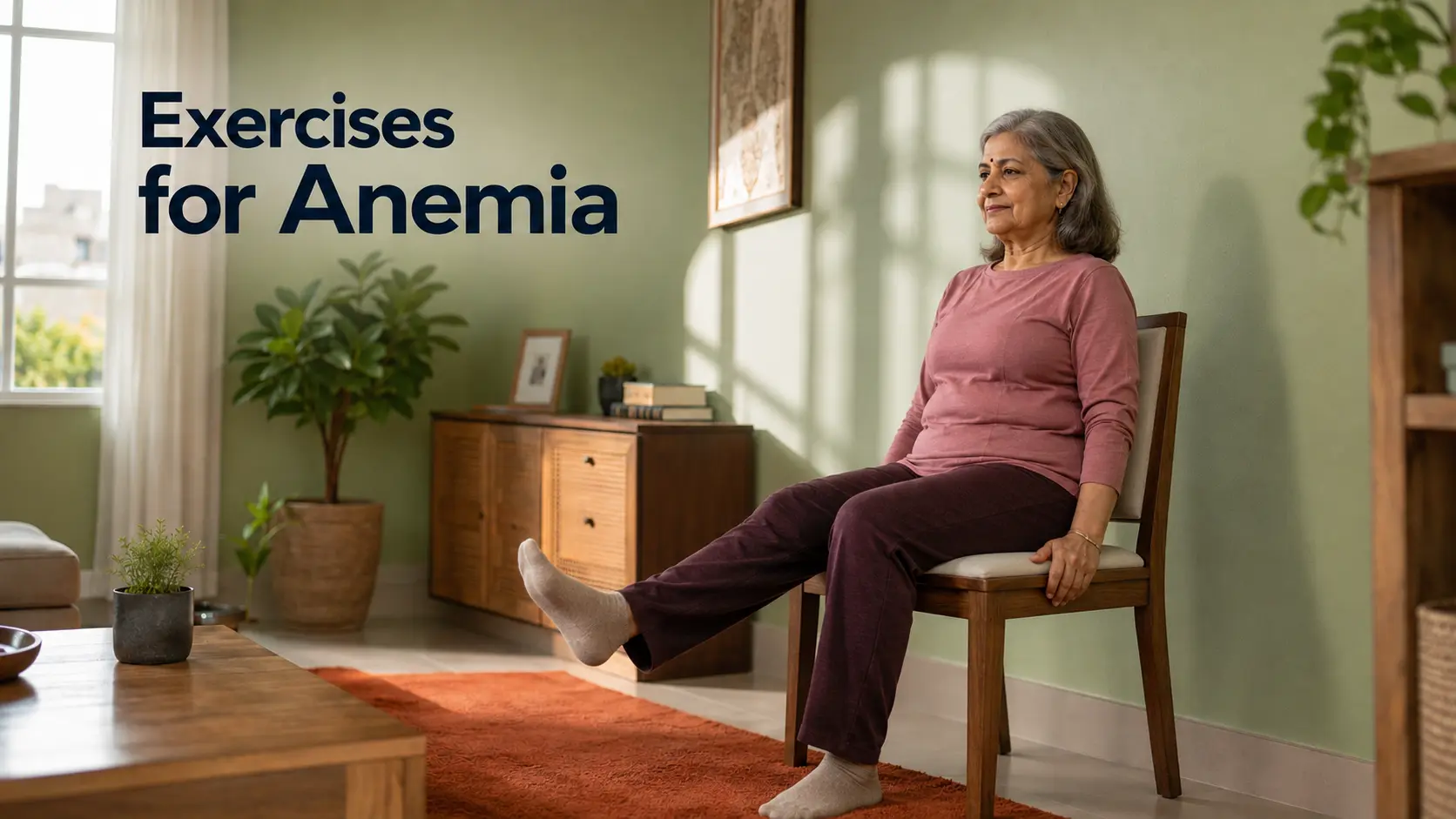
Sit upright in a chair with both feet flat. Slowly straighten one leg until fully extended, hold for 2 seconds, then lower it back. Do 10 repetitions per leg, once daily. This keeps the knee joint moving through its full range and supports the muscles used for standing up.

Recommended Reading:
For seniors dealing with pain alongside stiffness, these hip pain exercises for seniors address both in a similar low-impact format.
5/ Neck Side Tilt
Sit upright with both shoulders relaxed. Slowly tilt your head to bring your right ear toward your right shoulder until you feel a light stretch. Hold for 5 seconds, return to the centre, and repeat on the left. Do 5 repetitions per side, once daily. This keeps the neck moving through its full range, which helps with turning the head while walking or reversing a car.

All five exercises are best done at a pace that feels comfortable. The aim on day one is not maximum range but smooth, pain-free movement through whatever the joint allows.
What Happens When the Joints Stop Moving
Inactivity speeds up exactly what movement slows down. When joints are not taken through their range regularly, synovial fluid stops circulating, cartilage stiffens, and ligaments tighten further. The stiffness builds on itself.
CDC data cited by HUR USA shows 61% of adults aged 65 and older struggle with basic daily actions. Here is what that looks like in practice:
- Picking something up off the floor
- Reaching for an item on a shelf
- Getting in and out of a car
Range of motion exercises help restore what inactivity takes away. But flexibility alone only goes so far. The muscles around each joint also need to be strong enough to support the movement, or the range that mobility work restores tends to narrow again.
Recommended Reading:
Want to build a simple daily movement routine at home? These exercises for seniors at home are a good place to start.
Range of Motion Exercises for Elderly Also Need a Strength Foundation
Range of motion exercises restore the joint’s capacity to move. But the muscles carrying the body through those movements still need to be strong. Without that, the improvements from mobility work do not last long.
This is where the gap shows up most:
- Stiffness returns faster than it should
- Balance stays unreliable despite regular stretching
- The joint range that mobility work restores slowly narrows again
That muscle foundation is what strength training equipment for seniors, like Ferra, is built to develop. Ferra uses concentric-only resistance, meaning the machine resists your effort but never loads you on the way down. This removes the phase of exercise most likely to cause soreness or joint strain. Resistance calibrates automatically to current strength, so there is no risk of overloading.
Check out Ferra and build the strength that keeps your joints moving freely.
Conclusion
Doing range of motion exercise for elderly every day is one of the simplest ways to reduce stiffness and keep joints moving comfortably. Just a few minutes of gentle, pain-free movement can make everyday activities easier and help you move with greater confidence. For the best long-term results, pair mobility exercises with regular strength training to support your joints, improve stability, and help maintain your independence as you age.
Range of Motion Exercises for Elderly: Frequently Asked Questions
1/ How often should range of motion exercises be done to see improvement?
Daily movement produces better results than occasional longer sessions. Even 10 to 15 minutes of gentle joint movement each day helps maintain synovial fluid circulation and prevents stiffness from building up.
2/ Can range of motion exercises help seniors with arthritis?
Yes, with care. Movement helps keep joint fluid circulating and reduces stiffness. Exercises should stay within a pain-free range. If there is swelling or active inflammation, a doctor should be consulted before starting.
3/ Is stretching the same as range of motion exercises?
Not exactly. Stretching lengthens a specific muscle and holds the position. Range of motion exercises take a joint through its full available movement, involving the tendons, ligaments, and surrounding tissue. Both are useful, but ROM exercises cover more of what joints need to stay functional.
4/ How long does it take to notice improvement in flexibility?
Most people notice some reduction in morning stiffness within two to three weeks of daily movement. More measurable flexibility gains typically take four to six weeks, depending on current mobility level and consistency.
5/ Does resistance training help alongside range of motion exercises?
Yes. Mobility work restores the joint’s capacity to move, but the surrounding muscles need to be strong enough to support that movement reliably. Ferra uses concentric-only resistance designed specifically for seniors, making it possible to build that strength at home without the soreness or injury risk of conventional weights.

Anurag Dani is the Co-Founder of Ferra, a company dedicated to redefining healthy ageing through strength training. Drawing from his experience building fitness and healthy ageing solutions for adults, he writes about healthy ageing to help readers stay strong and independent as they age.