Why does starting resistance training feel harder than it should?
For many seniors, the exercise itself is not the problem. It is the equipment: heavy dumbbells, unfamiliar machines, and gyms that feel built for someone younger.
Resistance band exercises for seniors remove that barrier. Bands are light on the joints, inexpensive, and simple enough to start today, no gym membership or prior experience required.
This article covers why resistance training matters more with age, how to build a simple band routine at home, and how bands compare to dumbbells once you are ready to progress.
What Resistance Training Actually Means
Resistance training is any exercise that makes your muscles work against a force, whether that force comes from a band, a dumbbell, a machine, or your own body weight. The muscle contracts to overcome that resistance, and over time, this repeated effort is what builds strength.
It is different from cardio, which trains your heart and lungs, and different from stretching, which improves flexibility. Resistance training has one job: making your muscles stronger and more capable of handling everyday load.
- Band exercises: adjustable resistance from elastic tension
- Dumbbell exercises: fixed resistance from weight
- Bodyweight exercises: resistance from your own body
Whichever tool you use, the underlying goal stays the same: give your muscles a reason to keep working. Resistance band exercises for seniors are simply one practical way to apply that same principle at home.
Why Resistance Training Matters More With Age
Muscle mass does not stay constant. Research shows adults lose roughly 3 to 8 percent of their muscle mass per decade after 30, and that pace tends to pick up after 60. Left unaddressed, this loss shows up in ordinary moments, standing up from a low chair, carrying groceries up a flight of stairs, or catching your balance on an uneven surface.
Resistance training is one of the few tools that directly slows this process. Muscle responds to load at any age, which means a consistent routine can help rebuild strength that inactivity has worn down. Beyond strength itself, stronger muscles support the joints around them, which can ease pressure on aging knees, hips, and shoulders.
The benefit is not about appearance. It is about staying capable of the movements that make daily life easier and keeping independence intact for longer.
Why Resistance Bands Are the Easiest Place to Start
For a first-time or hesitant beginner, resistance bands solve several problems that dumbbells and machines do not.
- Lighter joint impact: bands provide smooth, elastic resistance rather than the sharp load of a fixed weight
- Lower cost and no gym visit: a full set of bands fits in a drawer and works from a chair or a hallway
- Easy to scale: light resistance for beginners, heavier bands as strength improves
- Naturally seated-friendly: most band exercises can be done sitting down
None of this makes bands the only option forever, but as a starting point, they remove the two biggest reasons people avoid resistance training altogether: intimidation and joint discomfort.
If a seated format feels more comfortable while you build confidence, these seated dumbbell exercises for seniors follow a similar chair-based approach and can be a useful next step once bands start to feel easy.
6 Beginner Resistance Band Exercises for Seniors
1/ Seated Row
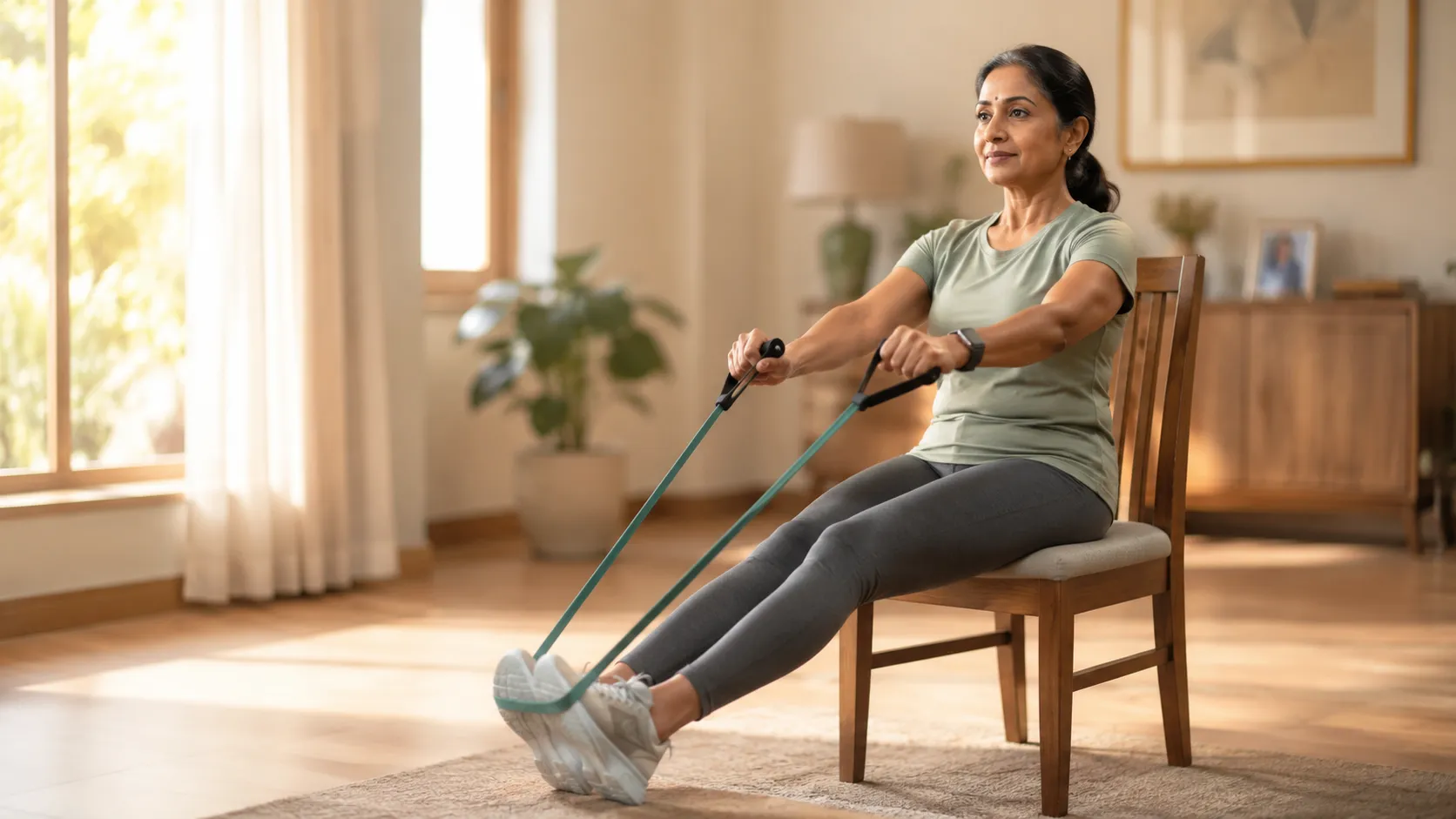
Sit on a sturdy chair with your legs extended forward. Loop the band around the soles of your feet and hold one end in each hand with your arms straight. Pull both hands toward your waist, bending at the elbows and squeezing your shoulder blades together. Slowly return to the starting position.
Why it matters: Strengthens the upper back and helps improve posture.

2/ Bicep Curl
Stand with both feet on the centre of the band and hold one end in each hand with your palms facing forward. Keeping your elbows close to your body, curl both hands toward your shoulders, then lower slowly. This exercise can also be performed while seated.
Why it matters: Helps maintain the strength needed for carrying and lifting everyday items.
Recommended reading:
For additional hand and forearm strength, you can also try these grip strength exercises for seniors.

3/ Chest Press
Sit upright in a chair and loop the band behind your upper back, holding one end in each hand. With your elbows bent at 90 degrees, push both hands straight out in front of you at chest height, then return slowly.
Why it matters: Builds upper-body strength used in everyday pushing movements.

4/ Banded Squat
Place the band just above your knees and stand with your feet hip-width apart. Push your hips back and bend your knees to lower into a squat as far as feels comfortable. Keep your chest upright throughout the movement. Press through your heels to return to standing.
Why it matters: Strengthens the lower body and makes everyday movements easier.

5/ Lateral Band Walk
Place the band just above your knees and stand with a slight bend in both knees. Step to one side until you feel the band tighten, then bring the other foot in to return to your starting stance. Complete all repetitions in one direction before switching sides.
Why it matters: Improves hip strength and supports balance.

Together, these five resistance band exercises for seniors cover the major muscle groups involved in everyday movement, from the shoulders and upper back down through the hips and legs. Consistency matters more than intensity here, and a full-body routine like this is what makes that consistency worthwhile.
A Simple Weekly Plan for Getting Started
A weekly plan does not need to be complicated to work. The goal in the first few weeks is simply building a rhythm you can repeat.
- Spread sessions across the week rather than doing them back-to-back, so muscles have time to recover between workouts
- Pair each session with a rest or light-movement day, such as a short walk
- Keep the resistance light for the first two weeks, then increase gradually once the movements feel controlled and comfortable
- Track how each session feels rather than chasing a fixed number of sessions right away
Recommended Reading:
If lower back stiffness makes some of these movements harder to hold, pairing this routine with these lower back exercises for seniors can help improve comfort before you continue building strength elsewhere.
What matters most is showing up regularly. A rhythm you can actually sustain over months will always outperform an intense routine you abandon after two weeks.
Bands vs Dumbbells for Seniors
Both tools work, but they solve slightly different problems, and knowing the difference makes it easier to choose where to start.
- Joint feel: Bands apply smooth, elastic resistance that builds gradually through the movement. Dumbbells apply the same fixed load throughout, including the lowering phase, which is often where soreness builds up.
- Cost and space: Bands are inexpensive and store in a drawer. A basic set of dumbbell exercises for seniors requires a small collection of weights and a bit more storage space.
- Progression: Bands progress in broader jumps between resistance levels. Dumbbells allow finer, more precise increases as you get stronger.
- Best for: Bands suit complete beginners and anyone prioritising joint comfort. Dumbbells suit those who have built a base of strength and want more precise progression.
Many seniors end up using both. Bands are a practical way to start and stay comfortable, and dumbbells become useful once your body is ready for more structured progression. As strength training becomes more comfortable, resistance training for seniors naturally becomes less about the tool and more about staying consistent with whichever one keeps you moving.
Resistance Training for Seniors Needs a Way Past the Fixed-Resistance Ceiling
Both bands and dumbbells share one limitation. Their resistance stays constant through the entire movement, including the lowering phase, which is where most of the joint strain and next-day soreness comes from for older adults. As strength improves, that same fixed resistance can start to feel either too easy or, on a stiff joint day, too much.
That is the gap strength training equipment for seniors like Ferra is built to close:
- Concentric-only resistance: resists your effort on the way up but applies no load on the way down, removing the phase that causes the most strain
- Adaptive resistance: adjusts automatically to your strength level as you progress, so there is no fixed ceiling to outgrow
Check out Ferra and build resistance training for seniors that keeps working as your strength does.
Conclusion
Getting started with resistance training does not require a gym membership or a rack of dumbbells.
A few resistance bands, ten minutes, and a routine you can repeat are enough to begin building real strength at home. These resistance band exercises for seniors matter, but the consistency behind them is what turns a short routine into lasting independence.
A few months of steady effort from here, and the everyday movements that once required a second thought will start to feel automatic again.
Resistance Band Exercises for Seniors: Frequently Asked Questions
1/ What is resistance training for seniors?
Resistance training for seniors is any exercise that makes muscles work against a force, such as a band, dumbbell, or bodyweight, to build and maintain strength. For older adults, it is one of the most effective ways to counter age-related muscle loss and support daily movements like standing, climbing stairs, and carrying items.
2/ Are resistance bands safe for elderly beginners?
Yes. Resistance bands are generally considered one of the safer entry points into strength training because they apply gradual, elastic resistance rather than a fixed load. Starting with a light band and focusing on controlled form further reduces the risk of strain or injury.
3/ How many days per week should seniors do resistance training?
Most general guidance suggests spacing resistance sessions across the week, with a rest day between sessions that work the same muscles, rather than training the same muscle group two days in a row. For band or dumbbell routines, that usually means a few sessions a week is enough to see steady progress. Machines like Ferra, which use concentric-only resistance and remove the joint strain of the lowering phase, are designed to be used more frequently without the same recovery trade-off.
4/ Are bands or dumbbells better for older adults starting at home?
Yes. Resistance bands are generally considered one of the safer entry points into strength training because they apply gradual, elastic resistance rather than a fixed load. Starting with a light band and focusing on controlled form further reduces the risk of strain or injury.
5/ Can resistance band exercises help with arthritis?
Many seniors with arthritis find resistance bands more comfortable than free weights because the resistance is gradual and controlled. However, exercises should never cause pain. Those managing joint stiffness may also benefit from these arthritis exercises for seniors.

Anurag Dani is the Co-Founder of Ferra, a company dedicated to redefining healthy ageing through strength training. Drawing from his experience building fitness and healthy ageing solutions for adults, he writes about healthy ageing to help readers stay strong and independent as they age.