Blogs
6 Dumbbell Exercises for Seniors: A Safe Beginner Routine at Home

Looking for safe dumbbell exercises for seniors you can start at home today?
A beginner dumbbell workout for older adults does not need heavy weights or a complicated routine. Done the right way, it is joint-friendly, builds strength gradually, and translates directly into daily tasks like carrying groceries, climbing stairs, and getting up from a chair with ease.
This guide walks through:
- Why dumbbells work well for seniors
- Safety rules to follow before you start
- A full beginner routine you can do at home
- How to choose the right starting weight
- How often to train each week
Here is why dumbbells are worth adding to your routine.
Why Dumbbells Work Well for Seniors
Dumbbells are simple to use and easy to store. More importantly, they mirror the movements that matter most in daily life:
- Pulling open a heavy door
- Lifting a bag of groceries off the floor
- Reaching for something on a high shelf
This is exactly the kind of strength that slips away with age. It is also the kind that dumbbell training directly rebuilds. Unlike bodyweight exercises, dumbbells let you prevent muscle loss progressively, adding small amounts of load as you get stronger so your muscles keep adapting.
That combination, simple to use and directly useful, is what makes a senior dumbbell workout worth the small investment of a pair of weights
Safety Rules Before You Start Dumbbell Training
A few simple rules make every session of your dumbbell exercises for seniors safer and more effective.
- Choose a manageable weight: If your form breaks down in the last few reps, the weight is too heavy. Start lighter than you think you need to. You can always progress.
- Slow reps matter more than heavy weights: Control the movement in both directions, lifting and lowering. The slower the rep, the more the muscle works.
- Keep a sturdy chair nearby: Useful for balance during standing exercises, especially in your first few sessions.
- Check with your doctor first: If you are managing a condition like hypertension, osteoporosis, or joint pain, get clearance before starting any new resistance routine.
Getting these basics right before you start is what keeps a beginner routine safe and sustainable, not just effective.
Recommended Reading:
If you are just starting and want a broader foundation to build on, these exercises for seniors are a good place to begin before adding weight.
A Full Body Routine for Seniors Who Are New to Dumbbell Training
1. Goblet Squat

Stand with feet shoulder-width apart, holding one dumbbell vertically at your chest with both hands. Bend your knees and lower your hips slowly until your thighs are roughly parallel to the floor, then press back up through your heels. Keep your chest tall throughout. This strengthens the thighs and glutes, the muscles that power every sit-to-stand movement.
2. Bent-Over Row

Stand with a dumbbell in each hand, knees slightly bent. Hinge forward at the waist about 45 degrees, keeping your back flat. Pull both dumbbells up toward your lower chest, then lower with control. This targets the upper back muscles that support posture and reduce mid-back fatigue.
3. Seated Overhead Press

Sit upright in a chair, holding a single dumbbell with both hands behind your head. Slowly press the weight overhead until your arms are almost fully extended, then lower it back down with control. This helps build shoulder and upper arm strength for lifting and reaching overhead.
4. Bicep Curl

Stand or sit, holding a dumbbell in each hand with palms facing up. Keeping your upper arms still, bend at the elbow and raise the weights toward your shoulders. Lower slowly. This builds the arm and grip strength used for carrying bags and holding railings.
5. Tricep Kickback

With a dumbbell in each hand, hinge forward slightly at the waist. Bend your elbows to 90 degrees, then extend your arms straight back until they are fully extended behind you. Lower with control. This targets your tricep, which you use any time you push or press something away.
6. Calf Raise

Stand behind a chair, holding the back lightly for balance and a dumbbell in your free hand. Lift your heels off the floor, hold for a second, then lower slowly. This builds ankle stability and supports steadier balance on uneven ground.
These six moves cover the full body with equipment that fits in a drawer, which is what makes this routine realistic to stick with.
How to Choose the Right Weight
Most beginners overthink this part. The right starting weight is the one that lets you complete every rep with good form, not the heaviest one you can lift.
- Upper body exercises (rows, curls, presses): start with 1 to 3 kg
- Lower body and full-body moves (squats): start with 2 to 4 kg
- If the last two reps of a set break your form, drop down in weight next session
You do not need a full rack. A single adjustable pair, or two to three fixed pairs in small increments, is enough to progress for months. The goal early on is not to lift heavy, it is to build the habit and the form first, then add weight gradually.
Choosing a slightly lighter weight than you think you need is almost always the safer, more effective starting point.
How Often Should You Do Dumbbell Exercises?
| Sessions per Week | What to Expect |
| 2 days per week | Safe starting point; muscles recover well between sessions |
| 3 days per week | Faster strength gains; ensure at least one rest day between sessions |
| Daily Short Sessions | Keep it light and movement-focused; save heavier dumbbell work for rest days in between |
The WHO recommends resistance training for seniors at least twice a week. But short, consistent movement every day builds the habit that makes strength training stick. Think of your two to three dumbbell sessions as the structured work, and lighter daily movement as the foundation that supports them.
Recommended Reading:
For context on how this connects to long-term muscle health, this article on beginner strength training covers what to expect in the first few weeks.
How Resistance Works in Dumbbell Training for Older Adults
The routine above works. But there is one part of dumbbell training that most beginners do not think about:
The lowering phase.
When you lower a dumbbell, your muscles are under load the entire way down. This is where most beginner problems actually show up:
- Muscle soreness that discourages the next session
- Joint strain that builds up over repeated workouts
- Injury risk is highest when fatigue sets in
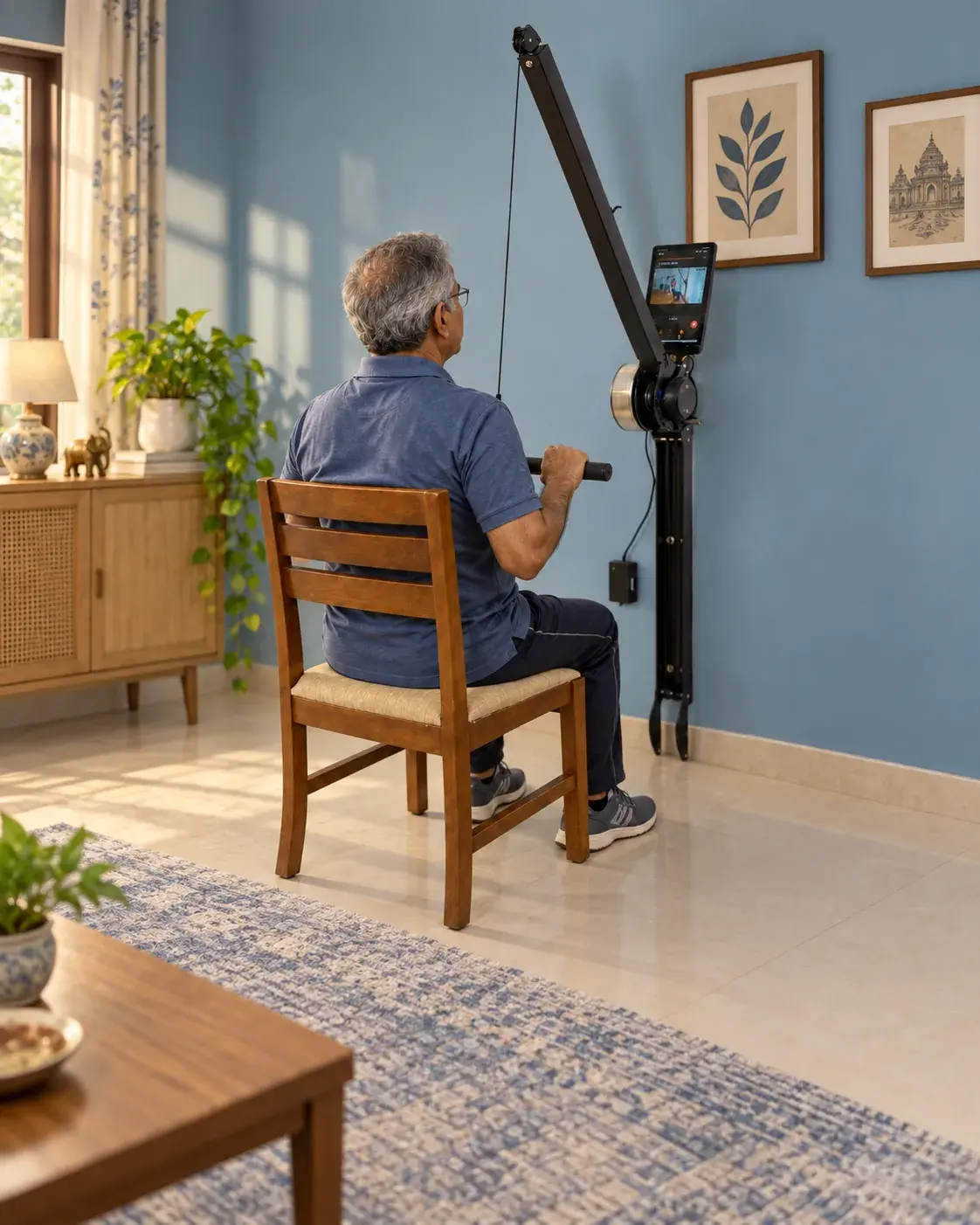
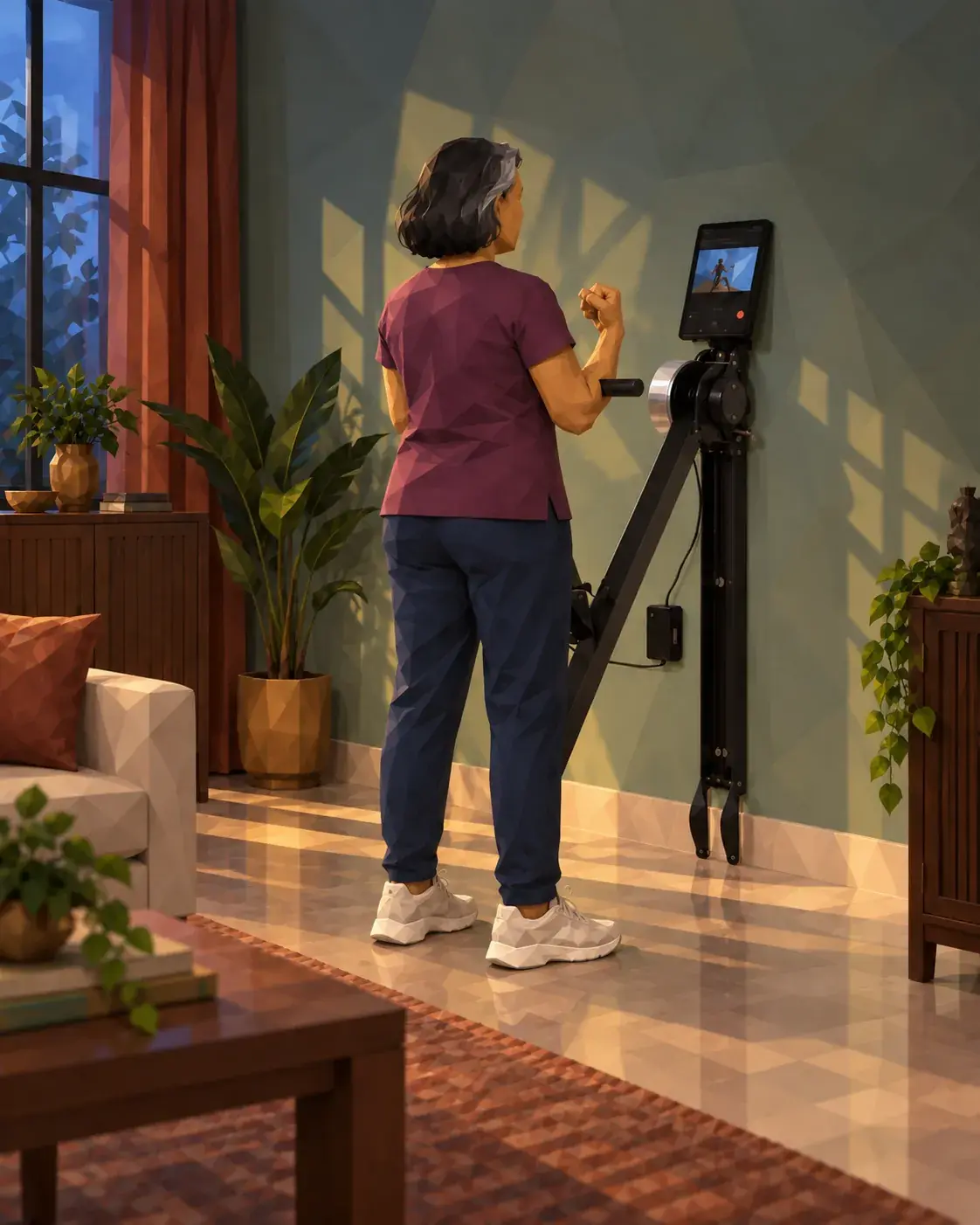
That limitation is what strength training equipment for seniors like Ferra is built to address. Ferra uses concentric-only resistance: the machine resists your effort on the way up but applies no load on the way down. This removes eccentric strain entirely. The resistance also adjusts automatically to your current strength level, so there is no risk of accidentally starting too heavy.
Check out Ferra and build strength that keeps daily movement feeling easy.
Conclusion
A beginner dumbbell routine does not need to be complicated. Six exercises, with weights you can actually control. That is a foundation most people can build on without soreness or injury setting them back.
The strength you build this way is practical. It shows up as steadier balance, easier stairs, and bags that feel lighter in your hands. A few weeks of consistent effort is usually all it takes before daily movement starts to feel noticeably different.
Frequently Asked Questions About Dumbbell Exercises for Seniors
1. How heavy should dumbbells be for beginners?
Start light enough to complete 10 reps with good form. For most beginners, 1 to 3 kg works for the upper body and 2 to 4 kg for the lower body.
2. Is this routine safe with knee or joint pain?
Yes, with modifications. Shorten the squat range, use seated upper body variations, and consult a physiotherapist if pain increases during or after a session.
3. Is daily dumbbell training safe?
Yes, daily exercise is safe, but the same muscle group should not be trained more than two to three times a week. Muscles grow during rest, not during training, so spacing out your sessions gives your body time to recover and get stronger.
4. How long before strength improvements show up?
Most people feel a difference within two to four weeks. Visible changes in daily tasks typically follow within six to eight weeks of consistent training.
5. Are seated dumbbell exercises as effective as standing ones?
Yes, for building upper body strength. Seated variations are particularly useful if balance is a concern, because they let you focus fully on the movement without worrying about stability. For lower-body exercises, standing versions tend to engage more muscles. Machines like Ferra, which use concentric-only resistance, are designed specifically so that seated and standing users both reach effective muscle stimulus without injury risk.
Build everyday strength — at your pace
Explore Ferra to see how strength training fits into life after 50 — it’s not about building muscle for its own sake, but moving with confidence.

Anurag Dani is the Co-Founder of Ferra, a company dedicated to redefining healthy ageing through strength training. Drawing from his experience building fitness and healthy ageing solutions for adults, he writes about healthy ageing to help readers stay strong and independent as they age.