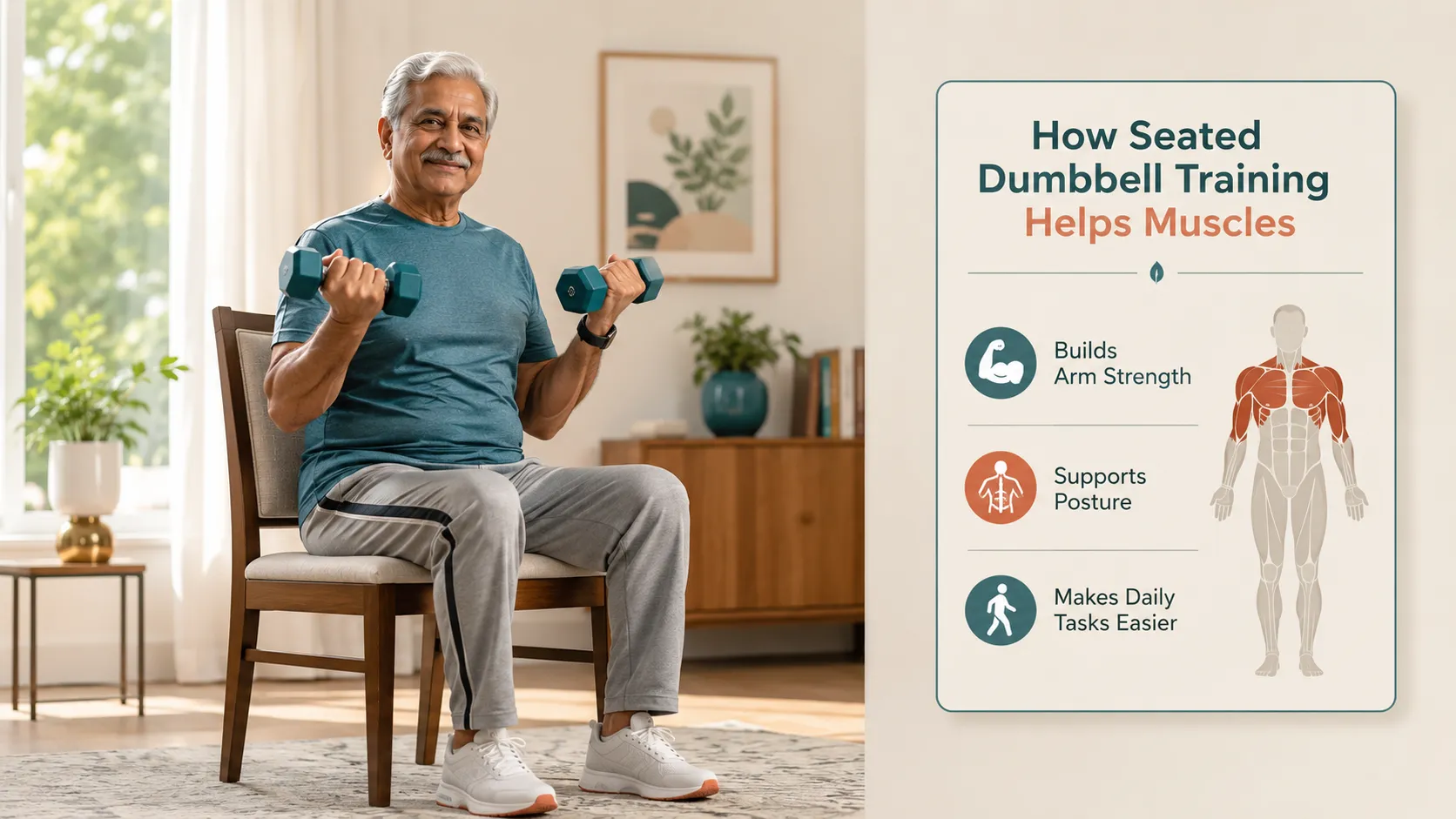
What if the safest way for seniors to build strength is to simply sit down?
Standing exercises can feel risky for seniors managing balance issues, joint stiffness, or the quiet fear of losing footing mid-rep. That hesitation often stops people from training at all, even when their muscles need the work the most.
In this article, we will walk through seated dumbbell exercises that help seniors work every major muscle group from a chair, with no standing required.
Before You Start: Chair Setup and Dumbbell Basics
A few basics make these sessions safer and more effective:
- Use a firm, stable chair without wheels, feet flat, knees at roughly 90 degrees
- Start with 1 to 2 kg dumbbells and prioritise control over load
- Keep reps slow, since slow reps produce more muscle stimulus than fast, swinging movements
- Expect muscle fatigue toward the end of a set, but stop if you feel sharp joint pain
Getting these basics right from the first session builds a habit that is safe to repeat daily.
5 Seated Dumbbell Exercises for Seniors
| Exercise | Muscle Group | Daily Function |
| Bicep Curl | Upper arm | Carrying bags, lifting objects |
| Overhead Press | Shoulders | Reaching shelves, lifting overhead |
| Lateral Raise | Shoulder stabilisers | Arm mobility, reaching sideways |
| Tricep Extension | Back of arm | Pushing, rising from a chair |
| Knee Extension | Quadriceps | Standing up, climbing stairs |
1/ Seated Bicep Curl
Sit upright with dumbbells in each hand, arms at your sides, palms facing forward.
- Curl both dumbbells up to shoulder height at a steady pace
- Lower slowly back to the start
- Do 10 reps for 2 sets
This targets the biceps, the primary muscle used whenever you carry or lift objects at arm length.

2/ Seated Lateral Raise
Sit upright with dumbbells at your sides, palms facing inward toward your thighs.
- Raise both arms out to the sides until they reach shoulder height
- Lower with control back to the start
- Do 10 reps for 2 sets
This works the lateral deltoid, which stabilises the shoulder joint during most arm movements.

3/ Seated Overhead Press
Hold dumbbells at shoulder height, palms facing forward, back supported against the chair.
- Press both arms straight up until fully extended
- Lower back to shoulder height with control
- Do 10 reps for 2 sets
This strengthens the shoulders and upper arms for reaching overhead and placing objects on shelves.

4/ Seated Tricep Extension
Hold one dumbbell with both hands and raise it overhead, upper arms close to your ears.
- Bend both elbows to lower the dumbbell behind your head
- Straighten your arms back to the start position
- Do 10 reps for 2 sets
The tricep is the muscle doing the work when you push up from a chair or any surface.

These five seated dumbbell exercises for seniors cover the upper body, lower body, and postural muscles.
Recommended Reading:
If shoulder stiffness shows up during the overhead press or lateral raise, these frozen shoulder exercises at home can help loosen things up first.
How Seniors Can Progress Safely with Seated Dumbbell Exercises
Building strength does not require long sessions. The secret is short, daily consistency. Pick just 1 or 2 exercises from this list to do each day, rotating through them across 6 days a week. Keeping the daily effort small protects your joints while building a powerful habit.
In weeks three and four, increase your reps from 10 up to 12. Once a single set feels manageable, add a second set to your routine. Short, regular sessions built around resistance training for seniors do more for long-term strength than longer sessions done occasionally. Consistency is the mechanism. Everything else follows.
Recommended Reading:
If lower back tightness comes up during the knee extension, these lower back exercises for seniors address the stiffness directly.
Seated Dumbbell Exercises Need the Right Kind of Resistance
Dumbbells are effective, but how resistance is applied matters just as much as the exercise. The lowering phase of a standard dumbbell rep is where most joint strain and soreness accumulates for older adults, since the muscle stays under load the whole way down. This is where strength training for seniors needs a different approach to resistance altogether.
Ferra, a strength training equipment for seniors, is built around exactly this gap. It uses concentric-only resistance, loading your effort on the way up but applying no force on the way down.
That shift removes the part of the rep that causes the most strain. At any point mid-rep, you can stop without weight pushing back against you, and the resistance adjusts automatically to your current strength level, so there is no risk of overloading as you progress.
Check out Ferra and build the seated strength that keeps daily movement easy and pain-free.
Conclusion
A chair is enough to build strength that shows up in real life: carrying groceries, climbing stairs, pushing up from a low seat. Seated dumbbell exercises for seniors make resistance training accessible without asking you to trade safety for results.
Pick an exercise or two, keep showing up, and let the consistency do the work. The strength you build this way does not stay in the chair. It carries into every part of how you move through the day.
Seated Dumbbell Exercises for Seniors: Frequently Asked Questions
1/ What dumbbell weight should seniors start with?
Most seniors do well starting with 1 to 2 kg. The right weight lets you complete 10 reps with control, but some effort in the last 2 to 3 reps. If you finish a set with no fatigue at all, go slightly heavier.
2/ Is it safe to do seated dumbbell exercises with arthritis?
Yes, in most cases. Low-impact resistance movements done with slow, controlled form can reduce joint inflammation over time rather than worsen it. Start very light and avoid any exercise that produces sharp joint pain. Machines like Ferra, which load only the lifting phase, are particularly suited to people managing joint conditions.
3/ Can seated dumbbell exercises help with lower back pain?
Indirectly, yes. Movements like the seated overhead press and lateral raise strengthen the shoulders and upper back muscles that support your posture. Better upper-body posture reduces the slouched position that places excess strain on the lower back over time. It is not a direct treatment for existing lower back pain. Avoid any movement that involves rounding or slouching the back under load, and consult a physiotherapist if pain is ongoing.
4/ How long before seniors see results from seated dumbbell training?
Most older adults notice improved strength and ease of movement within 3 to 4 weeks of consistent training. Early improvements are largely neurological as the body gets better at using the muscles it already has before new muscle tissue is built.
5/ Do seated dumbbell exercises build as much strength as standing ones?
Research comparing seated resistance training to standing functional training in older adults found no significant difference in physical performance outcomes after 12 weeks. For seniors where balance or stability is a concern, seated training often produces better results because form stays consistent throughout.

Anurag Dani is the Co-Founder of Ferra, a company dedicated to redefining healthy ageing through strength training. Drawing from his experience building fitness and healthy ageing solutions for adults, he writes about healthy ageing to help readers stay strong and independent as they age.